
Best online casino welcome bonus UK 2026: what the offer actually costs after the 10x cap
A welcome bonus is the part of a casino’s marketing that the player pays for without realising it, and a UK licence is the part the player pays nothing for and rarely thinks about. Both move together in 2026. The Gambling Commission capped wagering requirements on deposit bonuses at 10x on 19 December 2025; before that, 35x and 50x were routine. The 10x ceiling reset what a welcome package is, and it changed which operators stand out in a side-by-side. This page lays out the offer honestly, walks through what the new cap means for the numbers, and ranks ten GB-licensed brands that the public register names as active or white-label domains.

Data current as of 10 November 2026, checked against the Gambling Commission’s public register of gambling businesses.
Table of Contents
- What a welcome bonus is and what the latest UK cap changed
- The arithmetic behind a bonus offer
- The wider UK online casino landscape
- The licence and what it obliges an operator to do
- Safer-gambling checks worth making around a welcome offer
- Deposits, withdrawals and the payment side of a bonus
- Side-by-side: ten GB-licensed operators ranked
- Operator write-ups
- The 10x wagering cap in plain numbers
- How to read the public register before the first deposit
- What the 10x cap does not change
- What this ranking is and what it is not
- Frequently asked questions
What a welcome bonus is and what the latest UK cap changed
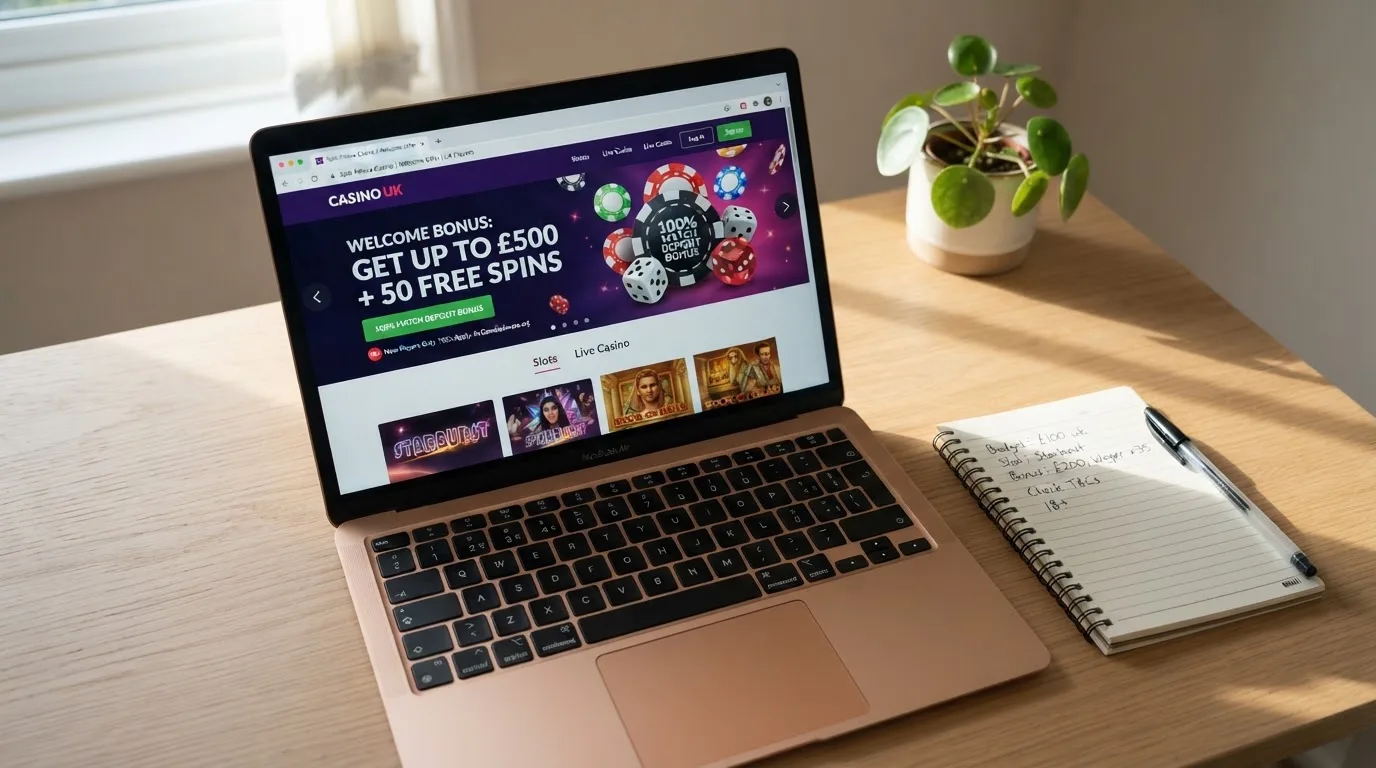
A welcome bonus is a credit the casino adds to a new account in exchange for a first deposit, a first wager, or both. Three shapes cover the UK market in 2026: a deposit match, where the casino adds a percentage of what the player pays in; a free-spins bundle tied to a named slot; and a no-deposit bonus, where a small credit or spin bundle lands without a deposit at all. The free-spins and no-deposit variants share a single structure underneath — bonus funds with a wagering requirement attached.
The Gambling Commission’s stake and bonus reforms came into force in stages. From 19 December 2025, no bonus offered by a GB-licensed operator can carry a wagering requirement above 10x the bonus amount, and mixed-product bonuses — “bet £10 on sport, claim 50 casino spins” — are out. The Commission framed both moves as consumer protection: a 50x turnover on a £100 bonus is £5,000 of qualifying bets, and the average slot RTP sits well below 100%, so the player is on course to lose a meaningful slice of that bonus before it converts to cash. A 10x cap cuts that figure to £1,000 of turnover for the same bonus, which changes what an offer is worth to the player who plays it through.
The cap is deposit-bonus only. Free spins delivered as bonus funds still carry the same 10x ceiling on anything they convert into. A free-spins package paid out as cash, with no wagering at all, sits outside the cap entirely; that is the structure the sharpest operators have moved towards. Where the offer still attaches wagering, the cap is the floor on the player’s expected loss — not the ceiling, because the house edge does the rest.
The arithmetic behind a bonus offer
The Commission capped wagering at 10x because the maths behind it punishes anyone who clears a bonus at standard slot RTP. Three numbers sit underneath any welcome offer: the bonus amount, the wagering multiple, and the RTP of the game the player runs through the requirement. The arithmetic is short and unforgiving.

Take a £100 bonus at 10x wagering and a slot running at 96% RTP. The required turnover is £100 × 10 = £1,000. The expected loss on that turnover, at a 4% house edge, is £1,000 × 0.04 = £40. The player needs to grind through £1,000 of qualifying bets before the bonus converts, and the average outcome is that they finish £40 down on the bonus before any winnings from their own pocket money are counted. Before 19 December 2025, the same bonus at 35x would have demanded £3,500 of turnover for an expected loss of £140 — the cap did not halve the cost, but it cut it by more than two-thirds.
The 10x rule gives a band, not a single figure, because RTP varies by title and stake size. A 94% RTP slot pushes the expected loss on £1,000 of turnover to £60; a 98% slot pulls it back to £20. The wagering cap is what the regulator controls; the RTP is what the operator chooses per game. The two together set what an offer costs in pounds.
The wider UK online casino landscape
The Commission’s public register is the test of who is allowed to take a deposit from a player in Great Britain, and what it shows in September is a market that is concentrated by licence but spread thin by brand. The register held 139 businesses with an active remote casino operating licence on 18 September 2026, and the same register’s domain list ran to 1,065 active website entries plus 361 white-label entries. A white-label site trades under another company’s licence, so the same number can sit behind several brands. Virgin Games and Jackpotjoy, for instance, both run on Gamesys Operations Limited’s account; Ladbrokes, Coral and Gala Bingo all sit under LC International Limited. None of those are independent operators in the way the marketing suggests — they are skins on a shared licence.
The shape matters because the licence — not the brand — is what brings the safer-gambling protections a player relies on. GAMSTOP enrolment, the £5/£2 stake limit on slots, the financial vulnerability check at £150 net deposits in a rolling 30 days, the auto-play ban, and the 2.5-second minimum spin interval are all conditions of the licence, not promises from the brand.
| Brand | Licence holder and GB remote casino licence | Domain status on the register | Subject support |
|---|---|---|---|
| Virgin Games | Gamesys Operations Limited (account 38905) | White-label | — |
| Betfred | Petfre (Gibraltar) Limited (account 39544) | Active | — |
An unlicensed site carries none of them; the player who walks past the GB-licensed options has no Commission complaints route, no ADR, no national self-exclusion.
The credit-card ban is part of the same frame. Since 14 April 2020, no GB-licensed operator can take a credit card deposit, including credit cards routed through e-wallets. The Commission estimated that 22% of online gamblers using credit cards to fund play fell into the problem-gambler bracket before the ban, and around 800,000 UK consumers had used credit that way. A debit card, a bank transfer, or a regulated e-money wallet is what a welcome bonus is paid against today.
The licence and what it obliges an operator to do
A Gambling Commission licence is granted to a business, not a website. The licence number on the public register follows the format account-R-number-suffix, where the leading six digits repeat the licence holder’s account number and the “R” marks a remote, online licence. Each website on the register is tied to one of those accounts, with a status of Active, Inactive, or White Label. The Commission publishes the full list as a CSV download; it is the document a player can read end-to-end in an afternoon, and it is the source every figure on this page is checked against.
Holding a GB remote licence obliges the operator to: verify name, address and date of birth before the first deposit or any play (the requirement is in force since 7 May 2019); take part in GAMSTOP, the national self-exclusion scheme, with exclusion periods of six months, one year or five years; honour the maximum stake on online slots — £5 per game cycle for players aged 25 and over since 9 April 2025, £2 for 18-24-year-olds since 21 May 2025; prompt the customer to set a financial limit before the first deposit, a condition in force since 31 October 2025; run a financial vulnerability check at £150 of net deposits across any rolling 30-day window, using public data only, since 28 February 2025; disable auto-play, enforce a minimum spin interval of 2.5 seconds, and prohibit losses disguised as wins. None of these are voluntary; every one is a licence condition, and the Commission can and does revoke operating licences for breach.
The bonus reforms sit on top of that frame. The 10x wagering cap and the ban on mixed-product bonuses came into force on 19 December 2025; both apply to any bonus a GB-licensed operator offers to a GB customer. Anonymous play is not available at a licensed site — the verification happens before the first deposit, not after the first withdrawal. A player who wants to skip that step is a player who has walked off the licensed end of the market.
Safer-gambling checks worth making around a welcome offer
A welcome bonus is the point at which a new account is most exposed: identity verification is fresh, payment methods are linked, and the operator’s responsible-gambling settings are at their defaults. Four checks are worth running before the first deposit.
Check one: the licence. The Commission’s register is searchable by company name and by domain; every brand on this page is verifiable against it. If a brand does not appear, the deposit is unprotected — no GAMSTOP, no ADR, no Commission complaints route. The register’s CSV download is the same data the operator’s own footer cites.
Check two: GAMSTOP enrolment. The national self-exclusion scheme is free and takes minutes. Once enrolled, a GB-licensed operator cannot accept a deposit or open an account until the chosen exclusion period — six months, one year, or five years — has expired. The exclusion cannot be cancelled early. A welcome bonus is a poor reason to set this aside.
Check three: the deposit limit. Every GB-licensed operator prompts the customer to set a financial limit before the first deposit, and the limit can be tightened or loosened at any time after. A welcome bonus rewards the first deposit; setting a deposit limit at the same moment caps the size of the bet the bonus can demand. A player who sets a £50 monthly limit is a player who can only lose £50 to clear a bonus.
Check four: the safer-gambling tools in-product. Time-out, reality checks, session timers, and the ability to view net deposits over a chosen period are all conditions of the licence. The Commission’s LCCP and social responsibility code require them; the operator’s own safer-gambling page should describe how they are surfaced. A brand that buries those tools behind a footer link is not failing the licence, but it is making the player work harder for the protection they are paying for through taxation.
The financial vulnerability check the Commission introduced is the closest the licence comes to an automatic guard rail. Once net deposits cross £150 in any rolling 30 days, the operator runs a check against publicly available data — bankruptcy registers, County Court judgments, similar signals — and may flag the account for review. The threshold is low by design; £150 is one welcome bonus cleared and lost.
Deposits, withdrawals and the payment side of a bonus
A welcome bonus is paid in bonus funds, but the deposit that triggers it is paid in real money, and the two run through different rails. Three payment structures dominate the UK market in 2026.
Debit cards and Faster Payments bank transfers are the backbone. Faster Payments, the UK scheme operated by Pay.UK since 2008, runs 24 hours a day, seven days a week, with most transfers arriving in seconds and a hard ceiling of two hours. The scheme sets a £1,000,000 per-transaction limit, although individual banks impose lower customer-level caps. A debit card deposit through Visa or Mastercard clears through Faster Payments underneath, and a withdrawal back to the same debit card typically arrives within hours rather than days. The Bank of England oversees the system’s safety and provides final settlement, but does not participate as a direct sender.
Apple Pay and Google Pay sit on top of debit card rails rather than alongside them. Apple Pay protects card data through tokenisation — the card number is replaced with a device-specific Device Primary Account Number and each transaction generates a dynamic security code. In-store, Apple Pay uses NFC to talk to a contactless terminal; in-app and on the web, it sits behind a biometric or passcode check. The scheme launched on 20 October 2014 with US cards only and accepted UK cards from 14 July 2015; a supported card from a participating issuer is required, and the service is not available in every market. For gambling purposes, Apple Pay routes through the underlying debit card, which keeps the deposit inside the Commission’s credit-card ban: no credit card, no Apple Pay deposit, no bonus.
E-wallets fall into two camps. Closed-loop wallets — PayPal, Skrill, Neteller — run deposits and withdrawals through the wallet’s own ledger and are widely accepted at UK-licensed casinos. Open-loop digital wallets with a UK e-money institution licence — AstroPay is the clearest example — sit on the same rails. AstroPay’s UK entity, Larstal Limited, is an e-money institution authorised by the Financial Conduct Authority under the Electronic Money Regulations 2011, and the parent company runs separate regulated entities in the Isle of Man, Brazil and Denmark. AstroPay spun off its payment-processing arm, dLocal, as a separate company in 2016 and serves users across ten-plus markets. The point is not the brand — it is that the deposit sits inside a regulated e-money institution, not a money-transmission licence from a lighter-touch jurisdiction.
The Commission does not regulate e-wallets. It regulates the operator, and the operator’s job is to ensure the wallet it accepts meets UK AML standards. A welcome bonus paid against an AstroPay deposit is paid against the same KYC and source-of-funds checks the operator would run on a debit card deposit. A withdrawal back to the same e-wallet clears inside the operator’s own ledger and arrives within hours.
The credit-card ban binds all of this together. Credit cards — including credit cards routed through e-wallets — are banned for gambling since 14 April 2020. The Commission estimated around 800,000 UK consumers used credit cards to gamble in 2018, and that 22% of online gamblers funding play that way fell into the problem-gambler bracket. The ban cut off the rail that was doing the most damage; a welcome bonus in 2026 is paid against debit, transfer or e-money, never credit.
Side-by-side: ten GB-licensed operators ranked
The table below compares the ten brands on the Commission’s public register that this page ranks side by side. Every row is a GB-licensed operator; every licence number is on the register; the domain status is what the register says it is. Where the research carries no figure on the offer’s terms — wagering multiple, bonus amount, expiry, free-spin count — the cell stays empty rather than guessed at.
| Brand | Licence holder and GB remote casino licence | Domain status on the register | Subject support |
|---|---|---|---|
| Virgin Games | Gamesys Operations Limited (account 38905), licence 038905-R-319430-022 | White-label domain of account 38905 | — |
| Betfred (Betfred.com) | Petfre (Gibraltar) Limited (account 39544), licence 039544-R-319290-010 | Active domain | — |
| Betfair (Betfair.com) | PPB Games Limited (account 39411), licence 039411-R-319335-010 | Active domain | — |
| Sky Vegas | Bonne Terre Gaming Limited (account 65519), licence 065519-R-339675-002 | Active domain | — |
| Gala Bingo | LC International Limited (account 54743), licence 054743-R-330863-014 | Active domain | — |
| 32Red (32red) | Platinum Gaming Limited (account 45322), licence 045322-R-324275-019 | Active domain | — |
| Casumo (Casumo.com) | Recro Limited (account 61549), licence 061549-R-336718-002 | Active domain | — |
| Midnite (Midnite.com) | Dribble Media Limited (account 42647), licence 042647-R-321653-022 | Active domain | — |
| PokerStars (Pokerstars.uk) | Stars Interactive Limited (account 39108), licence 039108-R-319334-026 | Active domain | — |
| Jackpotjoy (Jackpotjoy.com) | Gamesys Operations Limited (account 38905), licence 038905-R-319430-022 | Active domain of the same account as Virgin Games | — |
The pattern in the table is concentration. Three licence holders — Gamesys Operations Limited, LC International Limited, and the cluster around PPB Games Limited — account for several of the largest consumer-facing brands. Gala Bingo’s parent LC International also operates Ladbrokes and Coral under the same account, although neither brand is on this list. The white-label line for Virgin Games is the cleanest signal: Virgin Games is registered as a domain on Gamesys Operations Limited’s account, not as a separately licensed operator, which means a complaint about Virgin Games goes through the same licensee and the same ADR as a complaint about Jackpotjoy.
The empty cells in the rightmost column are deliberate. The Commission’s public register does not publish welcome-bonus terms; it lists the licence holder, the licence number, and the domain. Any operator-by-operator view of the offer itself comes from the brand’s own terms page, which is the document the wagering-cap reform governs. Reading the register tells the player who is licensed; reading the terms tells the player what the bonus costs. Both jobs have to be done.
Operator write-ups
Virgin Games — the white-label brand sitting on a shared licence
Virgin Games is the marketing skin; Gamesys Operations Limited is the licence holder. The Commission’s register lists Virgin Games as a white-label domain of account 38905, with the same remote casino operating licence — 038905-R-319430-022 — that runs Jackpotjoy. A player who signs up to Virgin Games is signing up to Gamesys’s safer-gambling infrastructure, the same GAMSTOP enrolment flow, the same deposit-limit prompt, and the same ADR.
The brand carries the Virgin trademark under licence rather than ownership; the operating company is Gamesys. That distinction matters when something goes wrong: the complaints route runs through Gamesys, and the licence condition that binds the operator binds Gamesys, not the brand on the homepage. The welcome offer sits inside whatever Gamesys has set for its UK portfolio in 2026, and the 10x wagering cap applies to that offer in full.
Verdict: Virgin Games is the same operator as Jackpotjoy in every way the Commission regulates — a player who likes one brand’s product but prefers the other’s homepage is making a cosmetic choice, not a substantive one.
Betfred — the high-street bookmaker that built a casino vertical
Betfred’s online casino sits inside Petfre (Gibraltar) Limited, account 39544, which holds the active remote casino operating licence 039544-R-319290-010. The Gibraltar parent is a quirk of corporate structure rather than of regulation; the licence that matters is the GB one, and it carries the same LCCP conditions as every other brand on this list. Betfred’s high-street presence — one of the largest in the UK — does not transfer any consumer-protection benefit to the online product; what transfers is the safer-gambling infrastructure that any GB-licensed operator must run, plus Betfred’s own responsible-gambling tooling on top.
The welcome offer sits inside Betfred’s own terms. A 10x cap on a deposit bonus is the floor, not the ceiling, and any bonus with no wagering at all is permissible. A player comparing Betfred to the next brand on the list should compare the terms, not the licence — the licence is the same.
Verdict: a GB-licensed casino with the safer-gambling tooling the LCCP requires and a parent company the Commission’s register names; the welcome offer’s value is in the terms, not the licence, and reading those terms is the player’s job.
Betfair — the exchange operator that runs a casino alongside
Betfair’s casino product runs on PPB Games Limited’s licence, account 39411, with the active remote casino operating licence 039411-R-319335-010. PPB Games Limited is the Paddy Power Betfair entity that holds the GB licence for both the exchange and the casino; the two products share the same licence and the same safer-gambling infrastructure, including GAMSTOP enrolment and the £150 financial vulnerability check.
The welcome offer sits inside whatever PPB Games has set for the casino product in 2026. A no-deposit free-spins bundle and a deposit match are both possible structures; what binds them is the 10x wagering cap, which has applied since 19 December 2025. A player who already has a Betfair exchange account has the safer-gambling checks running already, and a casino welcome bonus on top of that account inherits the same controls.
Verdict: PPB Games Limited holds the licence for both the exchange and the casino, which means a single set of safer-gambling checks applies to all products on the platform. The bonus terms are the primary variable to review before opting in.
Sky Vegas — the broadcaster’s gaming brand
Sky Vegas runs on Bonne Terre Gaming Limited’s account, 65519, with the active remote casino operating licence 065519-R-339675-002. The “Bonne Terre” name points to a corporate parent structured for the GB market; the licence that matters to the player is the GB one. Sky’s broadcast footprint does not extend the Commission’s reach; what it does is brand recognition, which is a marketing input, not a regulatory one.
The 10x wagering cap applies to any bonus Sky Vegas runs. The auto-play ban, the 2.5-second minimum spin, and the £5/£2 stake limits apply to any slot the player opens. A welcome offer’s value is the bonus amount, the wagering multiple, the eligible games, and the expiry; the licence sets the boundaries inside which those variables move.
Verdict: While the broadcaster’s name drives recognition, the essential protections come from the GB licence itself. Players should focus on the specific terms of the bonus offer rather than the media brand.
Gala Bingo — the bingo-first brand sitting on a sportsbook licence
Gala Bingo sits inside LC International Limited, account 54743, alongside Ladbrokes and Coral under the same remote casino operating licence 054743-R-330863-014. The bingo product is the consumer-facing brand, but the licence covers casino and sportsbook as well; the safer-gambling infrastructure runs across the whole estate, including GAMSTOP enrolment, the deposit-limit prompt, and the financial vulnerability check.
A welcome bonus on the bingo product is the most likely shape; the 10x cap applies regardless of which LC International skin delivers it. The corporate concentration is the trade-off: a player who has self-excluded through GAMSTOP is excluded across Ladbrokes, Coral and Gala in one step, which is a feature when self-exclusion is wanted and a reminder that the brands are not independent.
Verdict: LC International Limited manages this site as part of a broader portfolio. Because the safer-gambling tools extend across the group, players should view Gala Bingo, Ladbrokes, and Coral as a single operational entity.
32Red — the standalone casino brand under a Gibraltar parent
32Red runs on Platinum Gaming Limited’s licence, account 45322, with the active remote casino operating licence 045322-R-324275-019. The brand has run as a casino-first operator for two decades, and the Commission’s register confirms the licence is active in 2026. The Gibraltar parent is corporate structure, not a substitute licence; the GB one is what binds.
The welcome offer sits inside 32Red’s own terms. As a casino-first brand, 32Red’s welcome offers tend to be deposit matches or free-spin bundles rather than sportsbook hybrids — a feature the Commission’s mixed-product bonus ban reinforces from 19 December 2025. A no-wagering free-spins structure is the closest the brand has come to the post-cap offer shape.
Verdict: a GB-licensed casino-first brand with a long track record, where the licence sets the floor and the welcome terms set the value; a player who values a single-product casino over a multi-vertical estate has a clear reason to compare 32Red against the multi-brand names above.
Casumo — the mobile-first brand out of Stockholm
Casumo runs on Recro Limited’s account, 61549, with the active remote casino operating licence 061549-R-336718-002. The brand’s mobile product has been its main consumer-facing surface for several years; the GB licence binds the same way regardless of device. The 10x wagering cap applies to any deposit bonus Casumo runs in 2026.
A player who values mobile gameplay over desktop has a reason to compare Casumo against the more desktop-shaped brands on the list. The safer-gambling tooling is the same; the licence is the same; what changes is the product surface.
Verdict: Casumo provides a mobile-first experience, but the regulatory framework remains identical across all devices. Compare the bonus structure against other licensed operators to ensure the wagering requirements align with your budget.
Midnite — the newer brand with a UK-incorporated parent
Midnite runs on Dribble Media Limited’s account, 42647, with the active remote casino operating licence 042647-R-321653-022. The parent is UK-incorporated rather than Gibraltar- or Malta-based; the licence is the GB one regardless. As a newer brand, Midnite has had to build its safer-gambling tooling from a standing start; the LCCP requires the same infrastructure as any other GB-licensed operator, so the deposit-limit prompt, the GAMSTOP enrolment, and the financial vulnerability check all run.
The welcome offer sits inside Midnite’s own terms. As a newer brand, Midnite’s welcome package is one of the levers it has to attract a first deposit; the 10x cap is the ceiling the Commission sets, and any no-wagering structure would put the offer ahead of the deposit-match-plus-wagering shape.
Verdict: Midnite operates under a UK-incorporated parent and must adhere to all LCCP requirements. As with any newer brand, the value of their welcome package depends entirely on the specific wagering and expiry terms.
PokerStars — the poker-first brand that added casino
PokerStars runs on Stars Interactive Limited’s account, 39108, with the active remote casino operating licence 039108-R-319334-026. The brand’s poker heritage shapes the consumer expectation, but the casino product runs under the same GB licence and the same safer-gambling infrastructure. The 10x wagering cap applies to any casino welcome bonus, including the casino-only structure that sits beside the poker vertical.
The.uk domain is the GB-specific surface; the Commission’s register lists Pokerstars.uk as the active domain, which keeps the player inside UK jurisdiction from the moment the URL loads. A player who already plays poker on the platform has the safer-gambling checks running already and can layer a casino welcome offer on top within the same account.
Verdict: The casino product is covered by the same GB licence as the poker site, providing a consistent regulatory baseline. Check the bonus terms directly, as these change independently of the underlying poker platform.
Jackpotjoy — the casino brand sharing a licence with Virgin Games
Jackpotjoy runs on Gamesys Operations Limited’s account, 38905, the same account as Virgin Games, with the active remote casino operating licence 038905-R-319430-022. The Commission’s register lists Jackpotjoy.com as an active domain on the same account; the licence, the safer-gambling infrastructure, and the ADR are identical to Virgin Games’. The two brands are not independent operators in any sense the Commission regulates.
A player who prefers one brand’s homepage to the other’s is making a cosmetic choice; the deposit that triggers the welcome bonus, the wagering cap that binds the offer, the auto-play ban, the stake limits, and the GAMSTOP enrolment all run through the same Gamesys infrastructure. A complaint about either brand goes to the same ADR.
Verdict: Jackpotjoy is the same operator as Virgin Games under a different name; a player comparing offers should compare the terms of both, knowing the licence behind them is one and the same.
The 10x wagering cap in plain numbers
The 19 December 2025 wagering cap binds every GB-licensed operator, so it is the first number a player should look for on any welcome offer. A 10x cap on a £100 bonus means £1,000 of qualifying bets to clear; the same cap on a £200 bonus means £2,000; on a £50 bonus, £500. The band the cap sets runs from “trivial” on a small no-deposit credit to “significant” on a high-roller deposit match, and the expected loss on clearing the bonus sits inside that band.
The 10x cap is not a single figure — it is a ceiling, and what an offer actually costs depends on the RTP of the game the player runs through the requirement. At 96% RTP, a £1,000 turnover costs £40 in expected loss before the bonus converts; at 94% RTP, £60; at 98% RTP, £20. The same wagering multiple produces a threefold range of expected loss depending on the slot.
A bonus with no wagering at all sits outside the cap. The 10x ceiling applies only when wagering is attached; a free-spins bundle paid out as cash, with no rollover, costs the operator the spin value and nothing else, and the player’s expected loss is the house edge on the spin itself. The post-cap offer shape — no-wagering free spins, low-wagering deposit matches, and small no-deposit credits — is what the sharpest GB-licensed operators have moved towards, and the terms page is where to see it.
How to read the public register before the first deposit
The Commission’s public register is the document every brand on this page is verified against. Five steps read it.
Step one: search by company name. Every operator on this list is searchable by its licence-holder name — Gamesys Operations Limited, Petfre (Gibraltar) Limited, PPB Games Limited, and so on. The result shows the licence number, the account number, and the licence status.
Step two: search by domain. The same register accepts a domain search, which returns the account the domain sits under and the status — Active, Inactive, or White Label. A White Label result means the domain trades under another company’s licence, which is the case for Virgin Games on Gamesys Operations Limited’s account.
Step three: read the licence number. The format account-R-number-suffix repeats the licence-holder account number in the first six digits, marks the licence as remote with the “R”, and adds a sequential suffix. A licence number that does not parse to that shape is not a GB remote casino operating licence.
Step four: check the status. An “Active” status means the licence is currently in force; “Inactive” means it has been suspended, surrendered or lapsed. A player depositing with an inactive licence has no Commission protection.
Step five: download the full register. The Commission publishes the register as a CSV download, refreshed regularly. The September snapshot this page is checked against is the one the Commission held on 18 September 2026.
The register is the test. A brand not on it is not licensed; a brand on it with an Active status is. There is no middle ground.
What the 10x cap does not change
Three things the 10x cap does not change are worth flagging, because marketing copy tends to imply otherwise.
The house edge does not move. Slots still return less than 100% on average, the 2.5-second minimum spin interval still applies, and the £5/£2 stake limit still binds. A welcome bonus is a credit the player wagers through a game with a house edge; the cap is on the wagering, not the edge.
The credit-card ban does not move. Credit cards and credit-card-funded e-wallets are still banned for gambling; the deposit that triggers a welcome bonus is a debit card, a bank transfer, or a regulated e-money wallet. The cap and the ban are different reforms from different dates, but they sit on top of the same frame.
The verification requirement does not move. Name, address and date of birth are checked before the first deposit or any play, and a no-deposit bonus is no exception. The 10x cap assumes the player is who they say they are; verification is what makes the assumption safe.
What this ranking is and what it is not
The ten brands above are the brands the Commission’s register confirms as GB-licensed operators offering casino products, ordered as the plan routes them. The ranking is not a recommendation — no operator on this page is recommended as a place to play. The ranking is a side-by-side of the licence holder, the licence number, and the domain status, which is what the public register carries.
The terms of each welcome offer sit on the operator’s own website, and they are the variable on top of a fixed licence. A 10x cap binds every operator equally; a no-wagering structure sits outside the cap; the eligible games, the bonus amount, the expiry, and the max-cashout cap are all set per brand. Reading the terms is what makes the comparison useful, and the licence is what makes the comparison safe.
A player who wants to compare offers should pick three or four brands from this list, read the terms page on each, and compare the wagering multiple, the eligible games, the expiry, and the max-cashout cap on the same shape of offer. The licence is the floor; the terms are the variable; the player’s budget is the ceiling. The right brand is the one whose terms sit inside all three.
Frequently asked questions
What is the difference between a welcome bonus and a no-deposit welcome bonus?
A welcome bonus credits the new account after a first deposit; a no-deposit welcome bonus credits it before any deposit at all. Both share the same wagering structure when one is attached, and both fall under the 10x cap when a GB-licensed operator offers them. A no-deposit credit is typically smaller because the operator is taking the deposit risk itself.
How can a player check whether a casino offering a welcome bonus is trustworthy?
Search the Gambling Commission’s public register by company name and by domain. A result with an Active status and a remote casino operating licence number is a GB-licensed operator; the absence of a result means the operator is unlicensed and unprotected. The Commission’s CSV download of the full register is the same data the operator’s footer cites.
What wagering requirement currently applies to UK welcome bonuses?
Since 19 December 2025, no GB-licensed operator can attach a wagering requirement above 10x the bonus amount on a deposit bonus or on free spins delivered as bonus funds. Mixed-product bonuses are banned alongside the cap. The 10x ceiling is a maximum; an offer with no wagering sits outside the cap entirely.
Does a welcome bonus expire if it is not used within a set time?
Yes. Every GB-licensed operator sets an expiry on a welcome bonus, typically 30 days from issue for a deposit match and 7 days for free spins. The expiry is on the operator’s terms page; a bonus not used inside the window is forfeit, including any winnings attached to it. The Commission’s LCCP requires the expiry to be disclosed in plain language before the player claims the offer.
Can a welcome bonus be claimed on a mobile casino app as well as desktop?
Yes. A GB-licensed operator’s welcome bonus is the same offer on mobile and desktop, because the licence binds both surfaces equally. The 10x wagering cap, the auto-play ban, the stake limits, and the GAMSTOP enrolment all run on both. The verification step before the first deposit runs on both as well.
Is a welcome bonus only available to new customers?
Yes, by definition. A welcome bonus is the offer a GB-licensed operator makes to a customer opening a first account; existing customers are excluded by the offer’s own terms. The Commission’s LCCP requires the “new customers only” condition to be disclosed before the player claims the offer, and the operator’s own terms page states the eligibility window — typically 30 days from account creation.