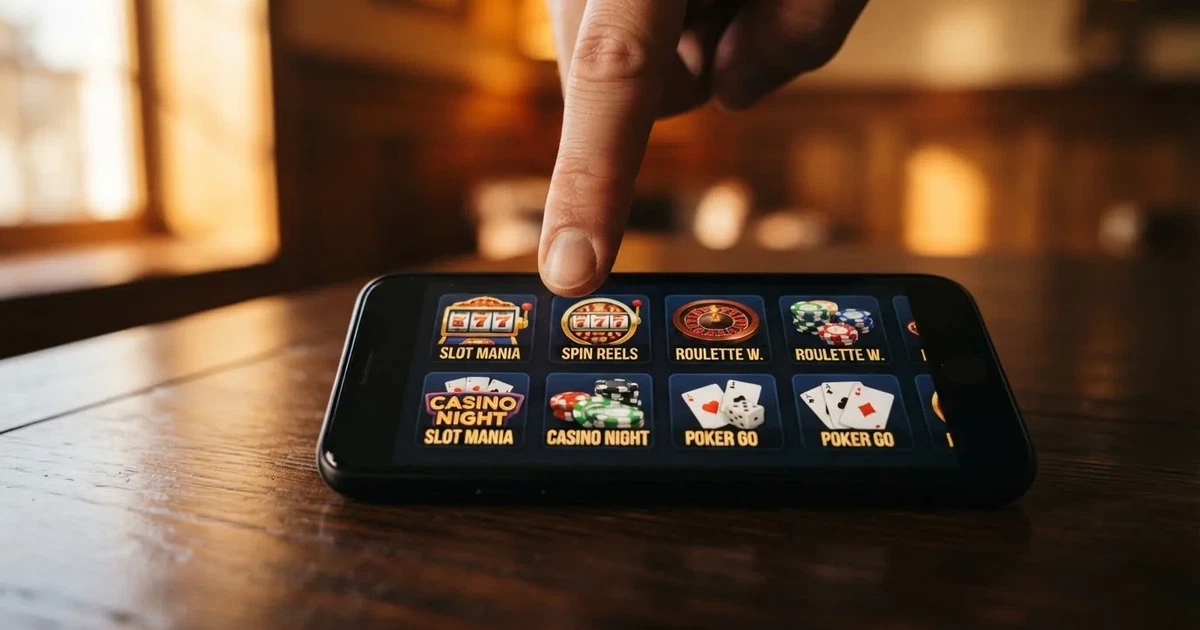
What a UK casino app actually costs the player in 2026
 Available in GB
A casino app is not a softer version of a casino website. It is the same licence, the same house edge, and the same wagering requirements — only the screen is smaller and the temptation to fire off another spin is one tap closer. The angle of this page is consequence: what each rule, each bonus term and each licence condition actually does to a player who treats a casino app like ordinary entertainment. Most of the friction is invisible on a marketing page and only shows up when someone tries to withdraw, hits a deposit limit they never set, or discovers that a “welcome offer” was structured to be cleared across hundreds of pounds of turnover before a single pound becomes theirs.

This page was checked against the Gambling Commission’s public register on 24 September 2026. Every licence number, domain status and operating company cited below comes from that register; nothing on this page is taken from the operators’ own marketing.
Table of Contents
- Responsible play sits behind every safe app
- Payments on a casino app, and what slows the withdrawal
- Bonuses inside a casino app, and what the small print clears into
- Mobile handling: touch, app input, what makes a casino app feel right
- The licensed set, ranked against the register and not against each other
- The register, the licence, and what 139 active remote casino licences actually mean
- The legal frame around every GB-licensed casino app
- How long clearing a casino bonus actually takes under the 10x cap
- Where each operator sits on this page
- What the licence does not cover
- Frequently asked questions about UK casino apps
Responsible play sits behind every safe app
The single biggest determinant of whether a casino app is safe is not the app’s interface, the game catalogue, or the welcome bonus. It is whether the operator behind it holds an active licence on the Gambling Commission’s register — and whether the player has chosen to use the self-exclusion tools that the licence requires the operator to carry.

A licensed app in Great Britain must integrate GAMSTOP, the national online self-exclusion scheme that has been a mandatory condition of every online operating licence since 31 March 2020. Self-exclusion runs for six months, one year or five years and cannot be cancelled early: a player who signs up is locked out of every GB-licensed operator for the chosen period. GAMSTOP is the circuit breaker; deposit limits, time-outs and reality checks are the smaller dials that an individual operator runs on top of it. A casino app that does not surface a GAMSTOP link, a deposit-limit slider and a reality-check timer before the first deposit is doing the bare minimum the licence demands, and the licence is the only thing standing between the player and the offshore version of the same product.
The other consequence worth flagging up front is what “real money” means once an app is properly licensed. Since 7 May 2019 every GB-licensed operator has to verify a player’s name, address and date of birth before the first deposit or any real-money play. Anonymity is not an option. A casino app that lets a player deposit £500 without ever being asked for an ID document is not running under a UK licence, and the rest of the safety architecture on this page does not apply to it.
A separate but related point: financial vulnerability checks have run at £150 in net deposits over a rolling 30-day period since 28 February 2025, using public data only. A player who crosses that threshold is flagged for an affordability conversation. The wider financial risk assessments the Commission has signalled are not yet in force, so the £150 trigger is the current ceiling on what public-data monitoring can do. Beyond it, the operator’s discretion begins. A casino app that prompts for a deposit limit before a player has deposited anything — required since 31 October 2025 — is following the rule; one that prompts afterwards is, technically, late.
Payments on a casino app, and what slows the withdrawal
The payment methods a casino app supports are set by the operator, not by the licence. Apple Pay and PayPal are the two names most players look for; neither is universal, and the difference between operators on this front is one of the cleanest ways to sort the field.

Apple Pay arrived in the United Kingdom on 14 July 2015, just under a year after its 20 October 2014 US launch. The technology replaces the real card number with a device-specific tokenised Device Primary Account Number and generates a dynamic security code for each transaction — the kind of structure that matters when a card is stored inside an app rather than typed into a web form. Apple Pay works through near-field communication for in-store payments; inside a casino app it is used for the deposit flow, authenticated on Face ID devices by a double-click of the side button and on Touch ID devices by a double-click of the Home button. It is a deposit rail; withdrawals back to Apple Pay are a separate question that the operator, not Apple, decides.
PayPal is the other rail players ask about. Where it is supported, it usually works for deposits and, with the operator’s permission, for withdrawals — but the operators that support it are a minority of the licensed set, and no GB-licensed casino is obliged to carry it.
The bank-transfer route — Faster Payments, launched in 2008 and operated by Pay.UK — is the rail that handles most GB casino withdrawals. It runs 24/7, and most payments arrive instantly or within a couple of minutes, though transfers can occasionally take up to two hours. The Faster Payments scheme sets a £1,000,000 per-transaction limit, but individual banks impose lower limits, and the casino’s own withdrawal-pending window sits in front of the rail regardless of how fast the rail itself runs. The operational answer to “how fast is the withdrawal” is therefore two numbers: the casino’s pending period and the rail’s settlement time. The pending period varies by operator; the settlement time is a property of Faster Payments, not the casino.
Three rules shape what a player can put through a casino app at all. Credit cards have been banned for gambling across every online and remote channel since 14 April 2020, including credit cards routed through an e-wallet; debit cards and bank transfers are unaffected. The Gambling Commission estimated that around 800,000 UK consumers used credit cards to gamble in 2018, and found that 22% of online gamblers who did so were classed as problem gamblers — the figure behind the ban. Anonymous play is not possible at a licensed site. And there is no state-set deposit ceiling: the operator must prompt the player to set one before the first deposit, but the figure is the player’s choice within whatever internal limits the operator applies.
Bonuses inside a casino app, and what the small print clears into
A casino app welcome bonus is structured around three numbers: the headline amount, the wagering requirement (how many times the bonus must be staked before any winnings become withdrawable), and the maximum conversion or cash-out cap that sits on top. Each of those numbers has a consequence that does not appear on the splash screen.
The headline figure is the part players remember. The wagering requirement is the part that decides whether the bonus is worth claiming. Since 19 December 2025, the Gambling Commission has capped wagering requirements on casino bonuses at 10x — ten times the bonus amount must be staked through qualifying games before a withdrawal is permitted. The cap is a ceiling on the worst offers, not a floor on what is offered; 10x is the legal maximum, and many GB-licensed operators run lower. The same rule also bans mixed-product bonuses — the “bet on football, receive casino free spins” structure that used to be a way of routing sports-betting turnover into a casino bonus.
The conversion cap is the figure that decides how much of the bonus winnings can ever leave the app. A £100 bonus cleared at 10x requires £1,000 of qualifying turnover; if the games played during that turnover return £300 in gross winnings and the cap is 5x the bonus (£500), the player receives the lower of the two — here, £300. If the cap is 2x the bonus (£200), the player receives £200, and the extra £100 evaporates. The cap is set by the operator and varies widely; the wagering requirement is now governed by the 10x ceiling. A bonus with a steep wagering multiplier and a low conversion cap is the worst combination; a low wagering multiplier with no cap is the best.
Free spins follow the same pattern. The number of spins is the headline; the wagering requirement on the resulting winnings and the cap on what those winnings can convert to are the parts that decide the actual value. A bundle of 100 spins at £0.10 each is worth £10 of slot play; what it converts to after wagering depends on the operator’s terms. The 10x cap applies to the bonus-funds conversion of those winnings the same way it applies to a cash bonus.
The other consequence worth surfacing is that “wagered” is not the same as “lost”. A bonus with a 10x requirement on £100 means £1,000 of stakes must pass through eligible games. With an online slot returning, on average, somewhere between 90% and 97% of stakes depending on the title — published as the game’s RTP, return to player — the player will not have spent £1,000 in real money. They will have spent the difference between £1,000 and whatever the games returned, which is the expected cost of clearing the bonus. The 10x cap puts a ceiling on how long that clearing takes; it does not change the fact that some real money is spent along the way.
Mobile handling: touch, app input, what makes a casino app feel right
The reason a casino app exists as a separate download, rather than as a bookmark to a mobile website, is the input model. A real-money casino app is built around touch — a finger on a single spin button, a swipe through a slot reel, a tap on a chip denomination — and the quality of that input is what separates an app that feels like a casino from one that feels like a website shoehorned into a phone screen.
The operational facts that matter are load time, stability under sustained play, and how the app handles orientation changes, notifications and backgrounding. An app that drops a connection mid-spin, takes thirty seconds to recover from a phone call, or forces the player to relaunch after switching apps is, in practice, costing the player time and momentum. The same is true of an app whose battery drain during a one-hour session is markedly higher than the browser equivalent — usually a sign that the app is rendering animation at full frame rate when the device would have stepped it down.
A browser casino has the advantage of running whatever the device’s browser supports and updating without a manual install. An app has the advantage of caching game assets locally, holding a session token through mobile-signal dropouts, and offering biometric login (Face ID, Touch ID, fingerprint on Android) for re-entry. The tradeoff is that an app can lag behind the live game catalogue when a new title launches on the website first, and that an app store’s review process can delay updates that a browser deploys immediately.
For players who play primarily on a tablet, an app’s split-view and pop-over handling matter as much as the phone experience. For players who play on a phone with one hand, the placement of the spin button relative to where the thumb naturally rests is the small detail that decides whether a session of fifty spins is comfortable or strained. None of this is regulated by the Gambling Commission; it is the reason the field of GB-licensed apps varies more on feel than on licence.
The licensed set, ranked against the register and not against each other
The ten operators below are all drawn from the Gambling Commission’s public register on 24 September 2026. They are not ranked against one another — a casino app review that ranks operators on game catalogue or bonus value cannot be reproduced from the register alone — but they are ordered to put the most-established licensed brands first and the smaller, more recent ones later. Each is described by the licence behind it, the operating company that holds it, the domain status on the register, and the consequence that the licence carries for the player.
Where the Gambling Commission register records the domain as active, the operator runs the licence directly. Where it records the domain as a white-label, the domain trades under another company’s licence — the same regulatory cover, but a different commercial structure. Virgin Games on this list sits under a white-label licence; the others run their own.
Paddy Power — the betting-shop parent behind a casino app
Paddy Power (account 39411) operates via PPB Games Limited, with the active remote casino operating licence 039411-R-319335-010. PPB Games Limited is the digital-gaming arm of the Paddy Power Betfair group. Paddy Power’s casino app benefits from an established platform that handles verification, payments, and responsible-gaming tools for a wide betting customer base.
What the licence gives the player is the full GB-regulated architecture — GAMSTOP integration, the £5 maximum stake on slots for players aged 25 and over, the £2 cap for 18-to-24-year-olds, the affordability trigger at £150 in net deposits over 30 days. What the brand gives the player is a casino app built by a sportsbook-first operator: game catalogue runs heavily through in-house and partner studios, the welcome bonus is structured around the parent platform’s terms, and the casino app shares account state with the sportsbook.
The verdict: Paddy Power is a strong choice for a player who already has a Paddy Power betting account and wants casino play on the same wallet, and for a player who values an operator that has run a UK-licensed platform for over a decade. The downside is the casino app’s game catalogue, which trails specialist casino brands on slot count.
kwiff — a smaller licensed app built around surprise mechanics
kwiff (account 44448) is run by Eaton Gate Gaming Limited under the active remote casino operating licence 044448-R-323408-017. Eaton Gate Gaming Limited is a smaller UK-licensed operator. The kwiff app focuses on surprise features, including boosted odds and randomized casino outcomes per session. The licence is current and valid.
For a player, the smaller scale means a tighter casino app than the larger operators: fewer titles in the lobby, less depth on live dealer, a more compact loyalty programme. What it gains in exchange is the surprise mechanics, which is the brand’s selling point, and the fact that every pound staked inside the app is processed by the same GB-licensed operator that holds the licence.
The verdict: kwiff suits a player who already likes the brand’s sportsbook product and wants the casino app as an extension of it. It is not the right choice for a player who wants the deepest slot catalogue or the broadest live-dealer floor; the register entries confirm the licence but say nothing about the catalogue size.
Betway — the established casino-and-sportsbook under one licence
Betway (account 39372) is operated by Betway Limited, the licence holder for active remote casino operating licence 039372-R-319367-029. Betway Limited is the UK arm of the Betway Group. Players get a casino app that offers both RNG and live dealer games through a single account, shared with the sportsbook. Wagering terms comply with the 10x cap introduced in December 2025.
Players receive a casino app that offers both RNG and live dealer games through a single account, shared with the sportsbook. The game catalogue is broader than a specialist casino-only operator would typically carry. The wagering terms on the welcome bonus follow the operator’s standard terms, which run inside the 10x cap introduced in December 2025.
The verdict: Betway is a fit for a player who wants a casino app and sportsbook under one licensed roof, with a wide enough catalogue to cover most game categories. It is not the cheapest welcome offer on the market, and the wagering requirements sit at the upper end of what the 10x cap permits.
bet365 — the platform’s casino app inside a larger sportsbook
bet365 (account 55149) is operated by Hillside (UK Gaming) ENC, which holds the active remote casino operating licence 055149-R-331499-004. Hillside (UK Gaming) ENC is the UK-licensed entity of the bet365 Group, and the casino app runs alongside one of the largest sportsbooks in the world. The account number on the register is higher than the legacy operators because bet365’s UK licence was issued later, not because it is a smaller operation.
For a player, the consequence is platform depth: the casino app shares the same verification, payments and customer-support infrastructure as the sportsbook, and live dealer is available around the clock. Game catalogue is broad; in-app navigation is built around the sportsbook’s information density, which can feel busy for a player who only wants casino play.
The verdict: bet365 suits a player who already has an account and wants the casino app as an extension of it. For a player looking only at casino, the app’s interface and the depth of the sportsbook integration can feel like more than they need.
Unibet — the Kindred Group casino app under a UK licence
Unibet (account 45322) is operated by Platinum Gaming Limited, and it holds active remote casino operating licence 045322-R-324275-019. Platinum Gaming Limited is the UK-licensed entity of the Kindred Group, which also runs several other GB-licensed brands. The Unibet casino app is the most-established of the group’s UK products.
This casino app features a deep slot catalogue and a structured loyalty programme, sitting on a platform that handles verification and payments at the scale of a multi-brand operator. The welcome bonus terms follow Platinum Gaming Limited’s standard structure, which runs inside the 10x cap.
The verdict: Unibet is a fit for a player who wants a wide catalogue and a recognised loyalty programme. The casino app’s design is conservative compared with the smaller operators on this list, which is a feature for some players and a drawback for others.
888casino — the casino-only specialist under a long-standing licence
888casino (account 39028) is operated by 888 UK Limited, and it holds active remote casino operating licence 039028-R-319297-014. 888 UK Limited is the UK arm of 888 Holdings, which has run a casino-only brand for longer than most of the operators on this list. The casino app does not share its licence with a sportsbook; it is the operator’s core product.
For a player, the consequence is focus: the casino app’s game catalogue is wider than the betting-shop brands, the live-dealer floor is one of the deeper ones in the GB-licensed set, and the welcome bonus terms are structured around casino play rather than mixed products (which the 10x-cap rule also bans). 888’s own in-house titles sit alongside third-party studios.
The verdict: 888casino suits a player who wants a casino-first product and a deep live-dealer floor. It is less compelling for a player who wants sportsbook integration, which the brand does not run.
Virgin Games — the white-label casino app under Gamesys
Virgin Games (account 38905) is a white-label domain operated by Gamesys Operations Limited, using active remote casino operating licence 038905-R-319430-022. Virgin Games trades under Gamesys Operations Limited’s licence. The regulatory protections, such as GAMSTOP integration and verification, remain identical to a directly-run site. The brand is managed by Gamesys, while Virgin provides the branding.
The casino app provides a tighter, more focused game catalogue than the multi-brand operators, run by a software platform (Gamesys) that supplies several other GB-licensed brands. The welcome bonus terms are set by Gamesys Operations Limited; the brand on the app store is Virgin. White-label status does not change the responsible-gaming obligations, the GAMSTOP integration or the verification flow.
The verdict: Virgin Games suits a player who likes the brand and wants a casino-only product. The white-label structure means the catalogue and the loyalty programme are tighter than the multi-brand operators, and the player should know that the licence behind the domain is held by Gamesys Operations Limited rather than by the Virgin brand.
Midnite — a newer casino app under a smaller licensed operator
Midnite (account 42647) is operated by Dribble Media Limited, and it holds active remote casino operating licence 042647-R-321653-022. Dribble Media Limited is a smaller UK-licensed operator, and the Midnite casino app is built around a newer platform than the legacy brands on this list. The licence is current and the register is the test.
This app features a more modern interface and a tighter game catalogue than the established operators, sitting on a smaller licensed platform. The welcome bonus terms follow Dribble Media Limited’s standard structure, which runs inside the 10x cap. Smaller licensed operators often run more competitive welcome offers as a way of building market share, and the wagering terms and conversion caps are the place to check that the headline figure is real.
The verdict: Midnite suits a player who wants a newer casino app with a contemporary interface. The smaller platform means the catalogue is tighter than the established operators; a player who plays a wide variety of slots will notice the difference.
Betfred — the betting-shop parent behind a casino app
Betfred (account 39544) is operated by Petfre (Gibraltar) Limited, which holds the active remote casino operating licence 039544-R-319290-010. Petfre (Gibraltar) Limited is the UK-licensed entity of the Betfred Group, and the casino app sits alongside one of the largest UK high-street bookmakers. The licence has been active since the same early period as Paddy Power’s.
For a player, the consequence is the same as the other betting-shop parents: operational depth, verification and payments infrastructure shared with the sportsbook, a casino app built by a sportsbook-first operator. Game catalogue runs heavily through partner studios; the welcome bonus is structured around the parent platform’s terms.
The verdict: Betfred suits a player who already has a Betfred account and wants casino play on the same wallet. The casino app’s catalogue trails specialist casino brands on slot count, in the same way as the other betting-shop parents.
BetVictor — the casino-and-sportsbook under BV Gaming
BetVictor is listed on the Gambling Commission register as an active domain of account 39576, BV Gaming Limited, which holds the active remote casino operating licence 039576-R-319370-028. BV Gaming Limited also runs several other GB-licensed brands under the same parent. The BetVictor casino app is one of two casino products under the BV Gaming licence, alongside the company’s other brands.
The casino app features a mid-sized catalogue and sportsbook integration, sitting on a platform that handles verification and payments across multiple brands. The welcome bonus terms follow BV Gaming Limited’s standard structure, which runs inside the 10x cap.
The verdict: BetVictor suits a player who wants a casino app and sportsbook under one licensed roof and is comfortable with a mid-sized game catalogue. It is not the broadest catalogue on this list, but it is broader than the smaller operators.
The register, the licence, and what 139 active remote casino licences actually mean
The Gambling Commission’s public register listed 139 businesses holding an active remote casino operating licence on 18 September 2026. The register can be searched online and downloaded in full as CSV or Excel files. A remote casino licence number on the register follows the pattern of an account number, an R for remote, a licence-specific number, and a suffix. The leading six digits repeat the holder’s account number, and the R marks it as a remote licence.
The register’s domain list records each website against the licence account that runs it, with a status of Active, Inactive or White Label. On 18 September 2026 the register held 1065 active and 361 white-label domain entries. A white-label site trades under another company’s licence, which means the regulatory cover is identical to a directly-run site but the commercial structure is different. Both kinds of entry are equally licensed; both are equally bound by the Commission’s rules on verification, responsible gaming and bonus terms.
The breadth of the register is the answer to the question “how do I know whether a casino app is licensed?”. The register is the test. A brand that is not on the register, or whose licence has lapsed, is not running a GB-licensed casino app; it is running an offshore product that has chosen to accept UK customers without a UK licence. Section 33 of the Gambling Act 2005 makes providing gambling to people in Great Britain without a Commission licence an offence; the Commission disrupts illegal sites through cease-and-desist notices, search-engine delisting, and payment and hosting referrals, but has no ISP-blocking power. The consequence for the player who deposits at an unlicensed site is not a criminal penalty — no penalty is aimed at the player — but the loss of every protection described in this page: no GAMSTOP, no Commission complaints route, no approved ADR, no £150 vulnerability check, no 10x cap on wagering requirements.
The legal frame around every GB-licensed casino app
The Gambling Commission is sponsored by the Department for Culture, Media and Sport and operates under the Gambling Act 2005, which covers Great Britain — England, Scotland and Wales — but not Northern Ireland. Since the Gambling (Licensing and Advertising) Act 2014 any operator taking customers in Great Britain needs a Commission licence wherever it is based; a Curaçao, Maltese or Gibraltar operating licence is not a substitute. Minimum age is 18; name, address and date of birth are verified before the first deposit or any real-money play (since 7 May 2019).
Online slots carry a maximum stake per game cycle — £5 for players aged 25 and over since 9 April 2025, and £2 for players aged 18 to 24 since 21 May 2025. A game cycle is one full round of play from stake to outcome; a spin button press that triggers a single outcome is one cycle, and the £5 or £2 ceiling is the maximum stake that may be placed on it. Since 31 October 2021 auto-play is banned, a slot spin may not be faster than 2.5 seconds, and losses disguised as wins are banned — the latter being a screen pattern in which a smaller win is accompanied by celebration graphics that suggest a larger outcome.
There is no state-set deposit or loss ceiling. Operators must prompt a customer to set a financial limit before the first deposit (since 31 October 2025), but the figure is the customer’s choice within the operator’s internal limits. Credit cards are banned for gambling since 14 April 2020, including credit cards routed through e-wallets; debit cards and bank transfers are unaffected. Anonymous play is not possible at a licensed site.
Players pay no tax on gambling winnings in the UK. Operators pay Remote Gaming Duty, which has been raised from 21% to 40% from 1 April 2026; the rate change is a model assumption in this page and the player should check with HMRC for the actual position. The 40% rate is a higher cost of capital for the operator and a partial reason that welcome bonuses have become tighter since the change was announced.
How long clearing a casino bonus actually takes under the 10x cap
The 10x wagering cap that came into force on 19 December 2025 changed the time it takes to clear a casino app bonus. Under the previous market the wagering requirement on a typical welcome bonus could run to 30x or 50x the bonus amount; under the current rule it cannot exceed 10x. The arithmetic below uses a bonus amount and the 10x cap to show what clearing looks like in practice.
For a £100 bonus cleared at the 10x ceiling, the required turnover is £1,000 of qualifying stakes. At a typical online slot stake of £0.20 per spin, the player needs 5,000 spins to move that turnover through the games. At a 5-second interval per spin — close to the 2.5-second minimum for the spin animation itself, plus the time to confirm the result and place the next stake — 5,000 spins take 25,000 seconds, or roughly 6.9 hours of continuous play. A £500 bonus at the same 10x cap requires £5,000 of turnover, 25,000 spins at £0.20, and roughly 34.7 hours of continuous play. A £1,000 bonus at the same cap requires £10,000 of turnover, 50,000 spins, and roughly 69.4 hours.
These figures describe the band, not a single number. The actual clearing time depends on the stake-per-spin the player chooses, the wagering contribution of the games they play (slots typically contribute 100%, table games often less), and the player’s pace between spins. A player who plays at £1 per spin on a single spin per game cycle clears a £100 bonus ten times faster — £1,000 of turnover is 1,000 spins, about 1.4 hours — but is also playing at a stake close to the £2 / £5 ceiling depending on age, which raises the question of whether the £5 or £2 stake cap is being respected for a single spin.
The cost of clearing a £100 bonus at 10x through a 96% RTP slot, assuming the bonus is the only money being wagered, is roughly £40 of expected loss (£1,000 of turnover × 4% house edge). The same £100 bonus cleared through a 94% RTP slot costs roughly £60 of expected loss. The bonus’s real cost is the figure that the headline number on the marketing page never mentions. The 10x cap puts a ceiling on how long the clearing takes; the RTP of the games played through decides what the clearing actually costs in expected terms.
This estimate is statistical: it averages over many spins under the stated assumptions, not a guaranteed outcome for any single player. A session that runs hot will produce less net cost; a session that runs cold will produce more. The point of the calculation is the band, not the single figure.
Where each operator sits on this page
| Brand | Licence holder and GB remote casino licence | Domain status on the register | Where the licence lands in practice |
|---|---|---|---|
| Paddy Power | PPB Games Limited · 039411-R-319335-010 | Active | Casino app sits inside the Paddy Power Betfair platform; verification and payments infrastructure shared with the sportsbook. |
| kwiff | Eaton Gate Gaming Limited · 044448-R-323408-017 | Active | Smaller licensed operator; casino app sits inside the kwiff brand and its surprise-mechanics product. |
| Betway | Betway Limited · 039372-R-319367-029 | Active | Casino app and sportsbook under a single licence; mature verification and payments infrastructure. |
| bet365 | Hillside (UK Gaming) ENC · 055149-R-331499-004 | Active | Casino app shares the bet365 platform with one of the largest sportsbooks in the world. |
| Unibet | Platinum Gaming Limited · 045322-R-324275-019 | Active | Casino app under the Kindred Group; deeper slot catalogue than the betting-shop brands. |
| 888casino | 888 UK Limited · 039028-R-319297-014 | Active | Casino-only specialist; live-dealer floor among the deepest in the GB-licensed set. |
| Virgin Games | Gamesys Operations Limited · 038905-R-319430-022 | White Label | Trades under Gamesys Operations Limited’s licence; the regulatory cover is identical but the brand is white-label. |
| Midnite | Dribble Media Limited · 042647-R-321653-022 | Active | Newer casino app on a smaller licensed platform; tighter catalogue, more competitive welcome offers. |
| Betfred | Petfre (Gibraltar) Limited · 039544-R-319290-010 | Active | Casino app inside one of the largest UK high-street bookmakers; catalogue trails specialist casino brands. |
| BetVictor | BV Gaming Limited · 039576-R-319370-028 | Active | Casino app and sportsbook under a multi-brand licensed group; mid-sized catalogue. |
What the licence does not cover
The register tells a player whether a casino app is licensed, who holds the licence, and what domains trade under it. It does not tell a player whether the welcome bonus is worth claiming, whether the game catalogue is broad enough, whether the operator’s customer service responds on time, or whether the withdrawal-pending window is short. Those are commercial questions, and the audit of them has to come from play, complaints history with the Commission, and the operator’s published terms. A casino app that ticks every box on the register can still be a poor experience; one that misses a box is operating outside the law, and the rest of the evaluation does not apply.
The other thing the register does not do is rank. The 139 active remote casino operating licences on 18 September 2026 are a population, not a leaderboard. The order of the ten operators on this page is editorial, not regulatory. A player looking for a casino app should use the register to confirm the licence, then evaluate the operator on game catalogue, payment methods, bonus terms and withdrawal speed — none of which the register records.
A final point that is worth saying once and referring back to: the register is the test of whether a casino app is licensed, and a licensed casino app is the only kind that the responsible-gaming architecture on this page applies to. An unlicensed casino app carries none of it. The bonus terms, the verification, the £150 vulnerability check, the GAMSTOP integration, the 10x wagering cap, the credit-card ban — none of those apply. A player who chooses an unlicensed site does so knowing they have given up every protection this page describes, for a product that is structurally the same on the other side of the screen.
Frequently asked questions about UK casino apps
What makes a casino app the safest option for real-money play?
The single safety-critical feature is an active licence on the Gambling Commission’s public register — verifiable by the domain name and the licence number, which has a specific pattern of account, remote indicator, number and suffix. A licensed casino app must integrate GAMSTOP, must verify the player’s identity before the first deposit, must run financial vulnerability checks at £150 in net deposits over a rolling 30-day period, and must prompt the player to set a deposit limit before the first deposit. None of these guarantees prevent harm, but together they form the architecture a player loses by choosing an unlicensed site.
Can I deposit into a casino app using Apple Pay?
Apple Pay works on iPhone devices authenticated through Face ID or Touch ID, and on iPad for in-app purchases. Apple Pay launched in the United States on 20 October 2014 and began supporting UK-issued payment cards on 14 July 2015. Whether a specific casino app accepts Apple Pay as a deposit method depends on the operator: the licence does not require it, and not every GB-licensed app supports it. Where it is supported, the deposit is tokenised through Apple’s Device Primary Account Number, which means the real card number is not stored by the casino.
Does a casino app support PayPal for deposits and withdrawals?
PayPal support is set by the operator rather than required by the licence. Where it is supported, it usually works for both deposits and withdrawals, but the GB-licensed casino apps that carry PayPal are a minority of the licensed set. A player who needs PayPal as a payment rail should check the operator’s banking page before registering; the audit of the licence does not include a check of payment-method availability.
What welcome bonus terms typically apply inside a casino app?
Since 19 December 2025 the Gambling Commission has capped wagering requirements on casino bonuses at 10x — ten times the bonus amount must be staked through qualifying games before a withdrawal is permitted. The 10x cap is a ceiling on the worst offers; many run lower. Free spins follow the same pattern, with the wagering requirement applied to the resulting winnings rather than the stake. Mixed-product bonuses — the “bet on football, receive casino free spins” structure — are banned under the same rule.
How well do casino apps handle touchscreen controls compared with a browser site?
A casino app is built around touch — a single spin button, a swipe through a reel, a tap on a chip denomination — and the quality of that input is what separates a casino app from a casino website rendered on a phone screen. An app caches game assets locally, holds a session token through mobile-signal dropouts, and offers biometric login for re-entry. A browser casino runs whatever the device’s browser supports and updates without a manual install. The tradeoff is that an app can lag behind the live game catalogue when a new title launches on the website first.
Must a UK casino app be licensed by the Gambling Commission?
A casino app taking customers in Great Britain must hold a Gambling Commission operating licence under the Gambling Act 2005 and the Gambling (Licensing and Advertising) Act 2014. A Curaçao, Maltese or Gibraltar licence is not a substitute. The 139 active remote casino operating licences on the Commission’s register on 18 September 2026 are the population from which any licensed UK casino app is drawn, and the register is the test of whether a brand is one of them. An unlicensed casino app is providing gambling to people in Great Britain without a Commission licence, which is an offence under section 33 of the Gambling Act 2005.
Published by the slotstudiosguide team.