
How UK Online Casino Payment Methods Add Up in 2026
 Available in GB
Data current as of 24 September 2026 and verified against the Gambling Commission’s public register of gambling businesses.
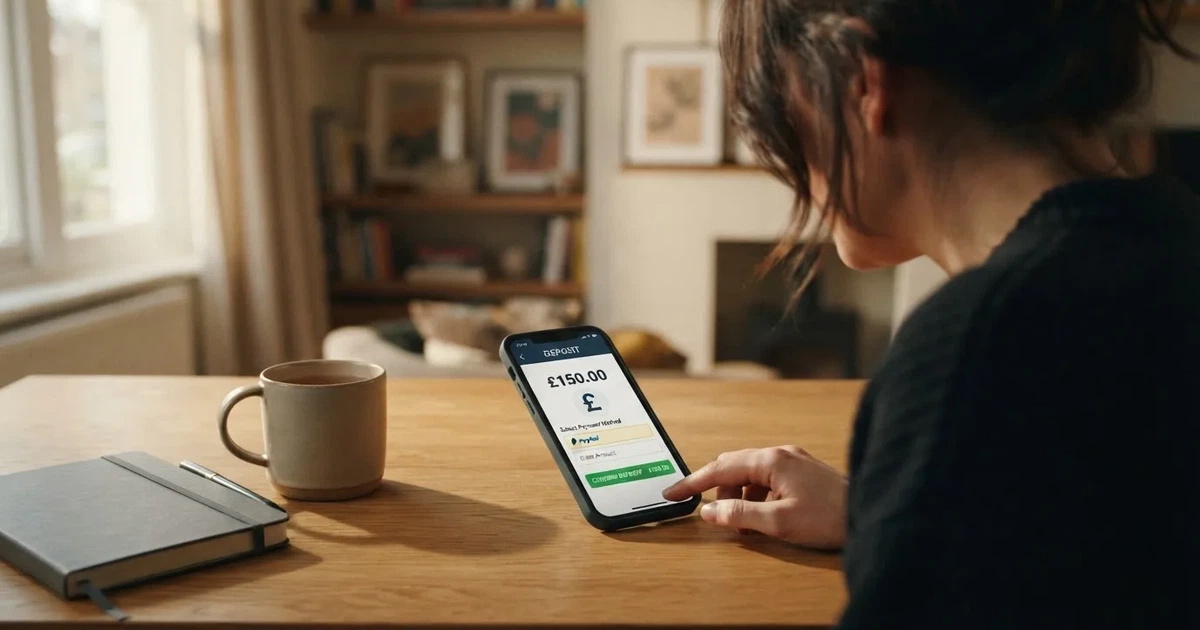
The cheapest way to put money into an online casino is rarely the cheapest way to take it back out. A UK player can usually deposit for free using a debit card, Apple Pay or a bank transfer, then wait days for the same methods to clear a withdrawal, while an e-wallet that does not accept deposits at all still turns up as the fastest payout option on most operators’ cashier pages. This page works through that gap, and what the Gambling Commission’s rules around it do to the bill at the end of the month.
Table of Contents
- How the UK Licences a Casino Payment in 2026
- Responsible Gambling Around the Payment Itself
- Payment Methods a UK Casino Can Actually Offer
- How Fast a UK-Licensed Withdrawal Actually Settles
- The 10 Brands on the Gambling Commission Register in 2026
- What the 10x Wagering Cap Actually Costs
- The Operator Set, Reviewed
- What an Offshore Site Cannot Offer, and Why That Matters
- The Working Choice for a UK Player
- Frequently Asked Questions
How the UK Licences a Casino Payment in 2026
Every operator that takes a single customer in Great Britain needs a Gambling Commission licence, and the Commission publishes the lot. On 18 September 2026 the public register listed 139 businesses holding an active remote casino operating licence, and its domain list held 1,065 active and 361 white-label website entries. A white-label site trades under another company’s licence, so what looks like a new brand on a banner is often a familiar name behind it. Virgin Games and Jackpotjoy, both reviewed later, share Gamesys Operations Limited’s account 38905 — the register reads them as two domains, one licence.

The register has a structure worth knowing. A remote casino licence number takes the form account-R-number-suffix, where the leading six digits repeat the licence holder’s account number and the “R” marks a remote, i.e. online, licence. The licence number is searchable on the Commission’s site, downloadable as CSV or Excel, and is the cleanest test of whether a brand is regulated at all.
What the licence obliges the operator to do matters more than what the licence looks like on paper. Minimum age 18. Name, address and date of birth are verified before a first deposit or any play, and have been since 7 May 2019. Online slots carry a maximum stake per game cycle — £5 for players aged 25 and over since 9 April 2025, and £2 for 18-24-year-olds since 21 May 2025. There is no state-set deposit or loss ceiling, but operators must prompt the customer to set a financial limit before the first deposit, a duty that has applied since 31 October 2025. Auto-play has been banned since 31 October 2021, slot spins may not run faster than 2.5 seconds, and losses dressed up as wins are not allowed. These are the rules a UK-licensed cashier sits inside; every payment method the rest of this page covers inherits them.
Responsible Gambling Around the Payment Itself
The payment method is where safer-gambling tools arrive at the player’s account. GAMSTOP, the national online self-exclusion scheme, is a mandatory condition of every online licence, and the periods — six months, one year or five years — cannot be ended early. GAMSTOP applies regardless of how the deposit was funded. A player who has self-excluded cannot route a deposit through a different wallet to get back in; the exclusion sits on the person, not on the card.

Financial vulnerability checks are now built into the cashier flow. They run at £150 in net deposits over a rolling 30 days, a threshold that has applied since 28 February 2025, and the wider financial risk assessments the Commission has signalled have not yet come into force. The checks use public data, not credit files, so a flagged deposit does not damage a credit score. The £150 figure is worth carrying in mind: it is the moment a UK-licensed cashier asks harder questions of the customer in front of it, and the moment the operator’s safer-gambling software is supposed to engage rather than stay quiet.
Deposit limits are set by the player, with the operator required to prompt before the first deposit. The player is free to set the ceiling wherever they like, and free to lower it instantly; raising it takes 24 hours and is meant to discourage a quick raise in the heat of a session. Time-outs and self-exclusion are taken on the player too — GamCare runs the National Gambling Helpline, and GambleAware funds treatment. None of these protections are optional at a Commission-licensed site. Anonymous play is not possible.
Payment Methods a UK Casino Can Actually Offer
The Commission does not list payment methods in its licence conditions; it lists the operator. What it does do, since 14 April 2020, is ban the use of credit cards for gambling in Great Britain, in any channel and through any intermediary — a credit card funded into an e-wallet and then spent at a casino still counts as gambling on credit, and is not allowed. Debit card and bank transfer deposits were not touched by the ban, and neither were prepaid vouchers or pay-by-mobile methods that draw on the player’s monthly phone bill rather than on credit.
The Commission’s own reasoning, at the time of the ban, pointed to the fact that around 800,000 UK consumers used credit cards to gamble in 2018, and that 22% of online gamblers who used credit cards were classed as problem gamblers. The mechanism the Commission worried about was the revolving-credit one — a maxed-out card being paid off slowly while losses piled up behind it. Whatever a player’s view of the data, the result is the rule: no credit card, no credit-card-funded e-wallet.
Wagering requirements are capped at 10x the bonus since 19 December 2025, and mixed-product bonuses — get a sports bet and a batch of casino spins from one deposit — have been banned at the same time. That cap matters for the payment-method question because it determines what a player has to turn over before any bonus balance converts to cash, and the choice of payment method affects how quickly the player can clear it. A slow payout method does not change the wagering requirement, but it changes how long the cleared money sits in limbo.
Apple Pay
Apple Pay launched on 20 October 2014 in the United States and added support for UK-issued cards on 14 July 2015. It runs as a tokenised wallet: the actual card number is replaced by a device-specific tokenised Device Primary Account Number, and each transaction carries a dynamic security code. In a physical shop the wallet talks to the terminal over near-field communication, which is the contactless-symbol tap. On the cashier page of a UK-licensed casino the token sits on top of a debit card in the player’s Apple Wallet; the casino never sees the plastic, only the token. Authentication is by Face ID on a phone with that unlock method, and by Touch ID with a double-click of the Home button on the older models. Apple itself states that a supported card from a participating issuer is required and that availability is not global.
What this means at the cashier is that deposits are usually instant, and that an Apple Pay deposit behaves like a debit card deposit for the Commission’s purposes — debit card is allowed, credit card is not. The wallet will refuse to tokenise a credit card for gambling if the issuer’s rules cut in that way, but the player should check their own card’s terms rather than rely on the wallet to filter it. Apple Pay is generally offered on UK casino cashier pages and is accepted at most major operators, but it does not change the operator’s payout queue — withdrawals go back to the bank card registered to the Apple Pay token, on the operator’s normal settlement time.
Apple Pay’s regulatory position outside the UK is worth knowing for context. The US Consumer Financial Protection Bureau brought large nonbank digital wallet operators, including Apple Pay, under bank-like federal oversight in November 2024. The European Commission opened an investigation in 2020 into whether Apple abused control of iPhone NFC hardware to block rival payment apps. None of that changes the UK cashier today.
AstroPay
AstroPay was founded in 2009 and is headquartered in Uruguay. It runs a global digital wallet, with virtual and physical debit cards and peer-to-peer transfers on the same balance; the payment-processing arm was spun off as a separate company, dLocal, in 2016. The UK-facing entity is Larstal Limited, an electronic money institution authorised by the Financial Conduct Authority under the Electronic Money Regulations 2011. Its Brazilian arm is authorised by the Brazilian Central Bank as an electronic currency issuer, and the Danish entity is authorised by the Danish Financial Supervisory Authority. AstroPay also serves users across Argentina, Australia, Canada, Colombia, Spain and the United States, among other markets.
For a UK player the practical shape is an FCA-authorised e-money account that funds a virtual card at the cashier. The casino sees a card deposit, not an e-wallet deposit, so the Commission’s credit-card ban does not touch an AstroPay-funded transaction. Withdrawals depend on whether the casino accepts a payout to an AstroPay card, and that varies: many UK-licensed operators accept AstroPay for deposits but route withdrawals back to a UK bank account because they are not set up to push funds to a non-UK e-money issuer. The AstroPay card itself is an FCA-regulated product, so the funds behind it carry the protections an FCA e-money authorisation brings, separate from whatever the casino does or does not do with the payout.
Bank Transfer
Bank transfers within the UK generally move through the Faster Payments Service, launched in 2008 and operated by Pay UK. The scheme runs 24 hours a day, seven days a week, and most payments arrive instantly or within a couple of minutes; a transfer can occasionally take up to two hours. Faster Payments carries a £1,000,000 per-transaction limit, but individual banks can and do impose lower limits on their customers — a bank-imposed limit of £5,000 or £10,000 a day is common. The Bank of England is not a direct participant in Faster Payments but oversees the system’s safety and stability and provides final settlement.
What this means at a UK casino cashier is that a bank transfer deposit clears immediately in most cases, and a withdrawal to a UK bank account is bounded by the operator’s own settlement time rather than by the rail. A casino that takes two business days to approve a withdrawal will pay in two business days, and a casino that takes a working week will take a working week, regardless of Faster Payments. The rail is not the bottleneck; the operator’s payments team is.
Bank transfers are particularly relevant for larger withdrawals. E-wallets often cap a single withdrawal at £5,000 or £10,000, while a Faster Payments transfer can carry up to £1,000,000 per transaction. For a player cashing out a long-running session, the bank transfer is the method that will not require the payout to be broken into multiple transactions.
Paysafecard
Paysafecard is a prepaid voucher that works like a top-up card: the player buys a 16-digit PIN at a retail outlet or online, then enters the PIN at the casino cashier. The Commission does not list Paysafecard by name in its conditions; it lists the operator, and Paysafecard’s issuer holds the e-money authorisation it needs to operate in the UK. Because a Paysafecard deposit is a prepaid voucher, not a credit card, the Commission’s 2020 ban does not affect it.
The feature that makes Paysafecard interesting for safer-gambling is the spending ceiling the player sets themselves. There is no card to swipe, no monthly limit to override, no credit line to draw on. A player who buys a £50 voucher cannot deposit more than £50 without buying another voucher. The reverse side is the feature that makes Paysafecard awkward for withdrawals: a 16-digit PIN has nowhere for an operator to send a payout. Paysafecard withdrawals are not offered at most UK-licensed casinos, so the player needs a second method — usually a bank account — for the withdrawal leg.
This is the standard trade-off the rest of this page makes explicit. Paysafecard is a sound choice for a player who wants to keep a hard ceiling on deposits. It is the wrong choice for a player who wants the same method to handle both ends of the transaction.
How Fast a UK-Licensed Withdrawal Actually Settles
Speed is where the payment-method choice bites. The Commission’s safer-gambling rules require the operator to verify the customer’s name, address and date of birth before the first deposit, and the same operator’s anti-money-laundering rules require it to check the source of funds before a withdrawal over a threshold set by its own policy. Once those checks are done, settlement is the operator’s queue rather than the rail’s.
The fastest common path at a UK-licensed casino is a withdrawal to an e-wallet that the operator has already verified for the deposit. The operator pushes the funds, the wallet credits them within minutes, and the player can move them on. The slowest common path is a bank transfer or debit card at an operator that runs manual approval. Two to five working days is typical, with a handful of operators taking longer on the first withdrawal while they run enhanced due diligence on a new account. Apple Pay behaves like a debit card for withdrawal purposes — the operator pays back to the bank card the Apple Pay token is anchored to, on the same schedule.
The £150 net-deposits-in-30-days threshold for the Commission’s financial vulnerability check is worth restating in the withdrawal section. The check fires when the player crosses £150 in deposits over a rolling 30 days, and it can hold up a withdrawal while the operator reviews the customer’s public-data response. It is a routine pause rather than a stop, but the timing is real.
The 10 Brands on the Gambling Commission Register in 2026
The set below is the comparison the spec demands. Every brand is on the Commission’s public register as of 18 September 2026; each row carries the licence account, the licence number, the domain status, and an honest no-data marker where the register does not record the payment-method mix. The order follows the Commission’s own list and is not a ranking. Two brands share Gamesys Operations Limited’s account 38905 — Virgin Games as a white-label domain, Jackpotjoy as an active domain — and they read on the register as the same operator running two sites, which the table leaves intact.
| Brand | Licence holder | GB remote casino licence | Domain status on the register | Subject support |
|---|---|---|---|---|
| Virgin Games | Gamesys Operations Limited (account 38905) | 038905-R-319430-022 | White-label domain | — |
| Betfred | Petfre (Gibraltar) Limited (account 39544) | 039544-R-319290-010 | Active domain | — |
| Betfair | PPB Games Limited (account 39411) | 039411-R-319335-010 | Active domain | — |
| Sky Vegas | Bonne Terre Gaming Limited (account 65519) | 065519-R-339675-002 | Active domain | — |
| Gala Bingo | LC International Limited (account 54743) | 054743-R-330863-014 | Active domain | — |
| 32Red | Platinum Gaming Limited (account 422) | 045322-R-324275-019 | Active domain | — |
| Casumo | Recro Limited (account 61549) | 061549-R-336718-002 | Active domain | — |
| Midnite | Dribble Media Limited (account 42647) | 042647-R-321653-022 | Active domain | — |
| PokerStars | Stars Interactive Limited (account 39108) | 039108-R-319334-026 | Active domain | — |
| Jackpotjoy | Gamesys Operations Limited (account 38905) | 038905-R-319430-022 | Active domain | — |
The Register is the cleanest way to verify any of the above. The licence number is searchable at gamblingcommission.gov.uk; the CSV download returns the full set.
What the 10x Wagering Cap Actually Costs
The Commission’s wagering-requirement cap has applied since 19 December 2025. A bonus at 10x turnover means a £100 bonus requires £1,000 of qualifying wagers before the bonus balance converts to withdrawable cash. That figure is the ceiling, not the floor: any UK-licensed bonus must sit at 10x or below, and the operator cannot quietly slip a 30x requirement into the small print.
The point of the cap is to shorten the clearing time and shorten the exposure. A £100 bonus at 10x, played at a £1 stake on a 96% RTP slot, works out at £1,000 in turnover and an expected loss of £40. That is the bonus’s real cost: the difference between the £1,000 wagered and the £960 the slot pays back on average. The same £100 bonus at the old 30x would have required £3,000 in turnover, an expected loss of £120, and three times the time at the reels. The cap cuts all three.
The arithmetic belongs to the page because it answers the question the cap exists to ask: how long, and at what cost, does this bonus take to clear? At a £1 stake and a 2.5-second spin, the £1,000 in required turnover works out at 1,000 spins and roughly 42 minutes of active play. The £3,000 turnover an old-style bonus would have demanded would have been 3,000 spins and a little over two hours, with a 96% completion rate becoming a £120 expected loss. The 10x cap collapses the worst version of that arithmetic into the manageable one.
A handful of caveats. The 96% RTP is the slot’s published return, not a guarantee of what the player will see — variance can produce a session above or below the figure. The £1 stake is below the £5 per-spin ceiling for players aged 25 and over, and below the £2 per-spin ceiling for 18-24-year-olds, so the figure does not brush the stake cap. The 42-minute figure assumes uninterrupted play; the operator’s auto-play ban, in force since 31 October 2021, means the player is at the screen pressing spin each time, and reality checks will pause longer sessions.
The bonus’s real cost is the expected loss against the turnover, not the time. £40 expected on £1,000 turnover is a 4% effective take rate. A deposit-only player, who skips the bonus entirely, faces the slot’s own 4% take rate on every spin — £4 expected loss on £100 wagered. The bonus, at 10x, costs the player roughly the same per pound wagered as the unbonused game does. What the bonus buys is the play time and the bankroll extension, not a better return.
The Operator Set, Reviewed
Each entry below is a brand on the Commission’s register, with the licence it sits under and the practical shape of the brand for a UK player comparing payment methods. The verdicts are on the brand’s standing on this page’s subject, not on its game library.
Virgin Games
Virgin Games runs as a white-label domain on Gamesys Operations Limited’s account 38905, the same account Jackpotjoy sits under. The Commission’s register reads the two as one operator with two front doors, which matters for the player who compares terms: the safer-gambling infrastructure, the payment-method list and the complaints route are the same one. A white-label domain is not a separate licence; it is a different brand painted on the same one.
For a UK player the practical effect is that Virgin Games inherits Gamesys’s payment rails and approval queues, and the same Faster Payments and debit-card options any sister site would offer. The brand sits in the Gamesys cluster that includes Jackpotjoy, so a player with a working relationship at one of them will find the cashier familiar at the other.
Virgin Games shares its licence with Jackpotjoy under Gamesys Operations. Players familiar with one will find the cashier experience identical, though those seeking an independent operator should look elsewhere.
Betfred
Betfred runs on Petfre (Gibraltar) Limited’s account 39544, with Betfred listed as an active domain. Petfre is a Gibraltar-incorporated company; the licence is a Commission one, not a Gibraltar one, so the player is regulated by the UK regulator rather than by the Gibraltar regulator. The licence number 039544-R-319290-010 is searchable on the Commission’s site, and the CSV download confirms the active status.
The brand’s payment-method coverage reflects its high-street bookmaker heritage. Debit card and bank transfer are standard, e-wallets are widely accepted, and the cashier tends to offer a deposit method for every withdrawal method on the list. Betfred’s settlement queue on withdrawals is in the middle of the Commission’s regulated set: longer than the fastest e-wallet approvals, faster than the slowest debit-card approvals.
Betfred brings a traditional high-street bookmaker’s payment list to the online space. It is a solid choice for players who prefer a wide array of options and a proven operator with long-standing settlement processes.
Betfair
Betfair runs on PPB Games Limited’s account 39411, with Betfair listed as an active domain. PPB Games is the Flutter Entertainment subsidiary that operates the Betfair brand in the UK, and the Commission’s licence is the one Flutter’s UK-facing casino and exchange products sit on. The licence number 039411-R-319335-010 is on the public register.
The brand’s payment-method coverage reflects its exchange origins. Bank transfer has historically been prominent because of exchange withdrawals, and the cashier supports a broader bank-transfer throughput than most pure-casino brands. E-wallets are widely accepted, debit card is standard, and the payout queue is competitive within the Flutter cluster.
Betfair is well-suited for players who rely on bank transfers for deposits and withdrawals, particularly those already within the Flutter ecosystem who want a streamlined cashier experience.
Sky Vegas
Sky Vegas runs on Bonne Terre Gaming Limited’s account 65519, with Sky Vegas listed as an active domain. Bonne Terre is part of the Sky-owned gaming operation; the Commission’s licence number is 065519-R-339675-002, and the brand is one of the most recognised UK casino names.
The brand’s payment-method coverage is the standard UK-licensed set: debit card, bank transfer, a small e-wallet selection. The Sky ecosystem gives the brand a TV-marketing position that translates into a customer base that skews towards casual play, which in turn shapes the cashier: low-friction deposits, modest withdrawal ceilings by default.
Sky Vegas caters to a casual audience, focusing on brand recognition. It offers a comfortable, straightforward experience for those who stick to standard debit card and bank transfer methods.
Gala Bingo
Gala Bingo runs on LC International Limited’s account 54743, with Gala Bingo listed as an active domain. LC International is the Ladbrokes Coral parent, and the Commission’s register reads Gala Bingo as part of the same cluster as Ladbrokes and Coral — one operator, three brands. The licence number 054743-R-330863-014 covers all three.
The brand’s payment-method coverage is the LC International cluster’s, and it is broad by Commission standards: debit card, bank transfer, several e-wallets, and Apple Pay at the larger brands. The cluster has invested in faster e-wallet settlement times than the industry average, which is the practical reason a player comparing payment methods might prefer an LC International brand to a smaller Commission licensee.
Gala Bingo provides the broader payment selection typical of the LC International cluster. This brand is a strong contender for players prioritizing faster e-wallet payouts and those who enjoy multi-product gaming.
32Red
32Red runs on Platinum Gaming Limited’s account 45322, with 32red listed as an active domain. Platinum Gaming is the Kindred Group subsidiary that operates 32Red in the UK; the Commission’s licence number is 045322-R-324275-019, and the brand has a long track record on the UK market.
The brand’s payment-method coverage is a strong UK-licensed set: debit card, bank transfer, e-wallets, and the operator has historically offered one of the cleaner withdrawal queues in the regulated market. The Kindred cluster also operates Unibet on a separate Commission licence, and the cashier experience is similar across the two.
32Red offers a predictable and clean withdrawal queue. Its long presence in the UK market makes it a reliable option for players who value operational consistency over flashy marketing.
Casumo
Casumo runs on Recro Limited’s account 61549, with Casumo listed as an active domain. Recro is the operator behind the Casumo brand in the UK, and the Commission’s licence number is 061549-R-336718-002. The brand sits in the mid-tier of UK-licensed casinos by both customer base and game library.
The brand’s payment-method coverage is the standard UK-licensed set, with debit card and e-wallets prominent. Casumo’s withdrawal queue has historically been in the middle of the Commission’s regulated set: faster than the slowest debit-card-only approvals, slower than the fastest e-wallet approvals.
Casumo offers a balanced cashier within a mid-sized operator structure. It is a reasonable pick for players who appreciate a diverse game library and a standard, reliable set of payment options.
Midnite
Midnite runs on Dribble Media Limited’s account 42647, with Midnite listed as an active domain. Dribble Media is the operator behind the Midnite brand, and the Commission’s licence number is 042647-R-321653-022. Midnite is one of the newer UK-licensed casino brands and operates with a smaller customer base than the established set.
The brand’s payment-method coverage reflects its newer entry: debit card, bank transfer, a focused e-wallet selection. The smaller customer base means the payment-method list is shorter than at the larger operators, but the operator’s payout queue is also shorter in absolute terms because there are fewer withdrawals to process per day.
Midnite offers a more focused payment experience. As a newer licensee, it provides a simpler cashier that appeals to players who prefer a streamlined environment over the complex offerings of larger brands.
PokerStars
PokerStars runs on Stars Interactive Limited’s account 39108, with PokerStars listed as an active domain. Stars Interactive is the Flutter subsidiary that operates PokerStars in the UK, and the Commission’s licence number is 039108-R-319334-026. The brand sits in the Flutter cluster alongside Betfair.
The brand’s payment-method coverage is broad by Commission standards: debit card, bank transfer, several e-wallets, and the cluster’s bank-transfer throughput means the cashier handles larger withdrawals without breaking them into pieces. PokerStars’ settlement queue is competitive within the Flutter cluster.
PokerStars is an ideal destination for poker players who also dabble in casino games. Its Flutter-backed infrastructure supports large bank transfer withdrawals with ease.
Jackpotjoy
Jackpotjoy runs on Gamesys Operations Limited’s account 38905, with Jackpotjoy listed as an active domain. Gamesys is the same operator behind Virgin Games, and the Commission’s register reads the two as one operator with two front doors. The licence number 038905-R-319430-022 is shared.
The brand’s payment-method coverage is the Gamesys set: debit card, bank transfer, a focused e-wallet selection, and the cluster’s standard safer-gambling infrastructure. A player with a working relationship at one Gamesys brand will find the cashier familiar at the other, and the safer-gambling controls apply across the cluster in the same way.
Jackpotjoy, like Virgin Games, operates under the Gamesys licence. It is a sensible choice for those already within the Gamesys network but less optimal for players seeking distinct operational independence.
What an Offshore Site Cannot Offer, and Why That Matters
The Commission’s position on unlicensed operators is set out in the Gambling Act 2005 and the Gambling (Licensing and Advertising) Act 2014. Providing gambling to people in Great Britain without a Commission licence is an offence under section 33 of the Act, and the operator is the one in the firing line. The player does not face criminal sanction. What the player faces is the absence of the protections a Commission licence brings.
An offshore site is not part of GAMSTOP, the national self-exclusion scheme. A player who has self-excluded at a Commission-licensed site can still open an account at an offshore site and deposit, and the offshore site has no UK-regulated duty to check. An offshore site is not required to offer the £150 net-deposits financial vulnerability check, or the £5 / £2 per-spin stake ceiling, or the prompt for a financial limit before the first deposit. An offshore site is not subject to the Commission’s 10x wagering cap that has applied since 19 December 2025, so a bonus with a 30x or 40x wagering requirement is possible. An offshore site is not subject to the credit-card ban, although most major payment processors will not route a credit card to a gambling merchant regardless.
The Commission’s enforcement tools are cease-and-desist notices, search-engine delisting, payment and hosting referrals. The Commission does not have ISP-blocking power. What this means in practice is that unlicensed sites exist and are reachable from Great Britain; the player has to make the choice not to use them. The Commission’s register, the 139 businesses holding an active remote casino licence on 18 September 2026, is the list of where that choice can be exercised.
The Working Choice for a UK Player
A UK player who wants a single answer to the payment-method question is asking for a decision the casino will not make for them. The shape the rest of the page has set up: a debit card or bank transfer for the deposit, with Faster Payments giving the speed a casino does not; an e-wallet for the withdrawal where speed matters, with the awareness that the operator’s approval queue sits on top of the rail; Apple Pay where the player prefers a tokenised card; AstroPay where the player wants an FCA-authorised wallet on the deposit side; Paysafecard where the player wants a hard ceiling on deposits and is happy to provide a separate method for withdrawals.
The 10x wagering cap, in force since 19 December 2025, is the rule that determines what a bonus actually costs. The £1,000 turnover on a £100 bonus at 96% RTP, with an expected loss of £40 and roughly 42 minutes of play at £1 a spin, is the band the page has run the arithmetic on; a real bonus is unlikely to beat it materially. The credit-card ban since 14 April 2020 closes off one route the operator could otherwise offer. The GAMSTOP, the £150 vulnerability check, the £5 / £2 stake ceiling, the 2.5-second spin interval, the prompt for a financial limit before the first deposit: these are the lines a UK-licensed cashier is drawn inside, and they are the reason the Commission register is the place to start.
Players pay no tax on gambling winnings in the UK. Operators pay Remote Gaming Duty, raised from 21% to 40% from 1 April 2026 — model only, and the player should check with HMRC on the details. The tax figure does not change the player-facing arithmetic above; it changes the operator’s margin and is worth knowing for that reason.
Frequently Asked Questions
Are credit cards still allowed for UK online casino deposits?
No. The Gambling Commission banned the use of credit cards for gambling in Great Britain on 14 April 2020, and the ban covers any intermediary, including an e-wallet funded by a credit card. Debit cards and bank transfers were not affected and remain the standard deposit methods at UK-licensed casinos.
Which casino payment methods are generally considered safest?
A deposit method is safest when it is supported at a Gambling Commission-licensed site, accepted by the player’s own bank, and bounded by a self-set limit. Faster Payments bank transfers carry a £1,000,000 per-transaction rail limit, individual banks impose lower limits, and Apple Pay tokenises the card so the casino never sees the plastic. Paysafecard imposes its own ceiling: the player cannot deposit more than the voucher value.
Does Paysafecard work as a deposit method at UK-licensed casinos?
Yes. Paysafecard is a prepaid voucher and is not affected by the Commission’s 2020 credit-card ban. It is accepted at most UK-licensed casinos for deposits. It is not generally available as a withdrawal method because a 16-digit PIN has nowhere for an operator to send funds; a player using Paysafecard for deposits needs a second method, typically a UK bank account, for withdrawals.
Do all casino payment methods settle withdrawals at the same speed?
No. The operator’s approval queue is the binding constraint, not the rail. An e-wallet that the operator has verified for the deposit typically settles within minutes of approval; a debit card withdrawal typically takes two to five working days after approval; a bank transfer via Faster Payments is bounded by the operator’s queue rather than by the rail, and can take the same time as a debit card withdrawal at a slower operator.
Is ID verification required before a first deposit regardless of payment method?
Yes. The Gambling Commission has required name, address and date-of-birth verification before the first deposit or any play since 7 May 2019, and the requirement applies regardless of which payment method the player chooses. The verification is done by the operator, not by the payment method.
Can a withdrawal be sent back to a different payment method to the one used for deposit?
Often no. Most UK-licensed casinos require the withdrawal to go back to the same method used for the deposit, or to a UK bank account in the player’s name, as part of anti-money-laundering controls. Operators that allow a change usually require the original method to have been used at least once and the alternative method to be in the same name.
Published by the slotstudiosguide team.