
What a no wagering casino really is in the UK, and where the rule ends
A UK player searching for a “no wagering casino” is, in practice, chasing one of three things: a bonus whose winnings arrive as cash rather than locked credit, a free-spins offer where whatever the reels pay out can be withdrawn the same day, or an account whose promotional structure never asks them to grind a stake multiple before cashing out. Each of those is real, each is offered by Gambling Commission-licensed brands, and none of them sits outside the UK rule book. They sit inside it.
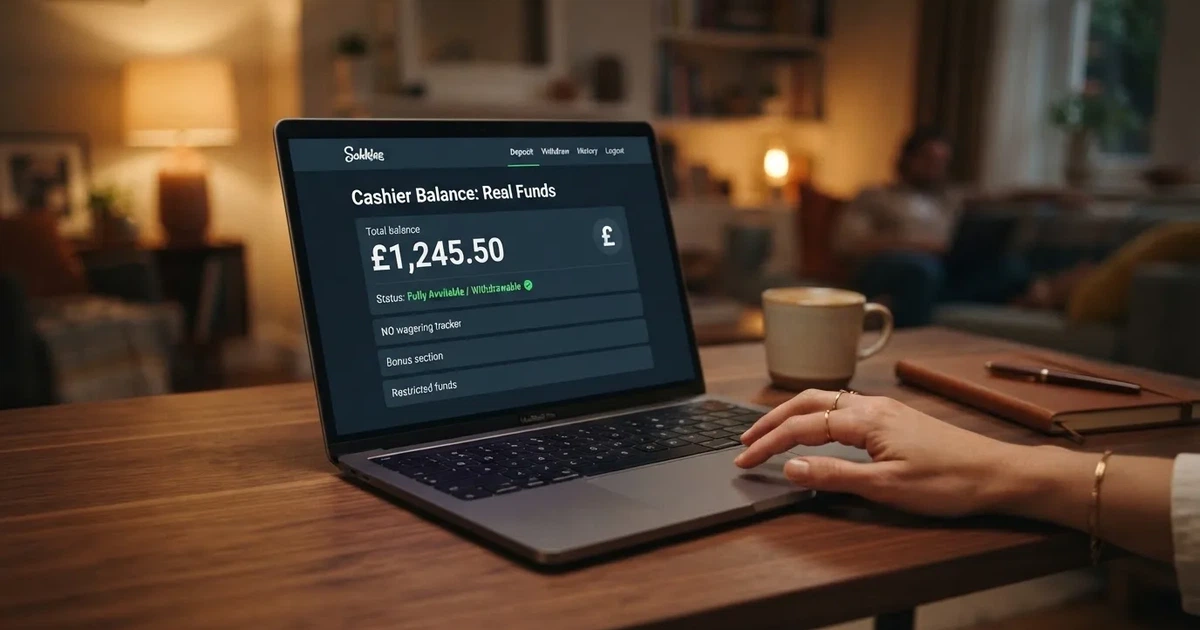
That rule book tightened materially during 2025. From 19 December 2025, any wagering requirement a UK-licensed site sets on a casino bonus is capped at 10x the bonus amount, and mixed-product offers — bet on sport, receive casino spins — are banned outright. A site that once set a 40x or 65x playthrough on a deposit match now has a hard ceiling it cannot exceed, and a category of bonus it cannot legally construct. The marketing word “wager-free” still appears in inbox subject lines, but the universe it describes has narrowed, and the comparison the reader is making has shifted with it.
Currency stamp: figures checked against the Gambling Commission public register on 10 November 2026; bonus and stake rules read against the LCCP and social responsibility code as in force.
This page works through what is actually on offer to a British player in 2026, what each offer costs in time and money once the marketing copy is set aside, and how ten licensed brands sit alongside each other when the rules are the same for all of them. It is not a buyer’s guide. The Commission register decides who is licensed; the player decides what they want from the offer. The job in between is to make the comparison honest.
Table of Contents
- Responsible gambling controls that apply on every UK-licensed no wagering offer
- Crypto and anonymity, and what the UK rule does to both
- Payments, payout speed, and what shows up on a no wagering account
- Bonuses, free spins, and the 10x ceiling
- How ten UK-licensed no wagering brands compare
- How the UK market for licensed online casinos is shaped
- Legality, regulation, and what the licence does and does not guarantee
- Each brand in this comparison, in turn
- What the page’s calculation actually shows
- Where the reader’s actual decision sits
- Frequently asked questions
Responsible gambling controls that apply on every UK-licensed no wagering offer
A no wagering casino account in Britain is still a Gambling Commission-licensed account, and the safer-gambling tools sit on the licence, not on the offer. Strip the wagering requirement out of a promotion and the duty to protect the player remains. The two changes are different things done by different clauses, and the reader who confuses them ends up reading the bonus terms when they should be reading the account terms.

Every UK-licensed casino, including any site branded as wager-free, must integrate GAMSTOP, the national online self-exclusion register. A self-exclusion can be set for six months, one year or five years, and the period cannot be shortened once it begins. GAMSTOP blocks new account creation across every UK-licensed operator at once, which is precisely why it is mandatory on every licence rather than optional. A player who wants the friction of opening a wager-free account during a difficult stretch gets it the same way they would on any other Commission-licensed site: by waiting out the exclusion. There is no wager-free exception.
Financial vulnerability checks layer on top. From 28 February 2025 a check fires once net deposits cross £150 in a rolling 30-day window, run against public-data sources such as the electoral register and insolvency records. The check is light-touch at that threshold — a flag, not a stop — but the wider financial risk assessment framework has been signalled and is expected to land in stages. The rule applies identically whether the account carries a wagering requirement or not. A bonus the player can withdraw in a day does not exempt the player from a financial check at the end of the month.
Deposit limits are the player’s own tool rather than a Commission-set ceiling. There is no statutory deposit cap; instead, every operator must prompt the customer to set a financial limit before the first deposit, a duty in force from 31 October 2025. The prompt is not optional, the limit the player chooses is, and the limit applies to the account regardless of which bonus is active. A reader who treats a wager-free offer as licence to deposit freely has misread the prompt as decoration.
Time-outs and reality checks are account-level, not promotion-level. A time-out is a short cooling-off period — 24 hours, a week, a month — set by the player on their own account. A reality check is an in-session pop-up reminding the player how long they have been playing. Both apply whether the session is on a wager-free promotion, a standard bonus or no promotion at all. Auto-play has been banned since 31 October 2021, and a single spin on an online slot must take at least 2.5 seconds. The 2.5-second floor is the same on every slot the player can reach from a wager-free offer.
Three help channels sit outside any single operator: GamCare runs the National Gambling Helpline, GambleAware funds treatment and education, and GAMSTOP is the self-exclusion route. A reader who needs any of these does not lose them by choosing a wager-free brand.
Crypto and anonymity, and what the UK rule does to both
A “crypto casino no wagering” search lands mostly on offshore sites — Curaçao, the Comoros, Anjouan — where the licence is the regulator’s licence and the operator’s own terms do the rest. The offer the search returns is, on paper, exactly what the term describes: deposit in Bitcoin or Ethereum, play a slot, withdraw the win, no playthrough, often no KYC at all on small balances. The offer is real; what sits around it in Britain is the problem.

The Gambling Act 2005, as amended by the Gambling (Licensing and Advertising) Act 2014, makes it an offence to provide gambling to people in Great Britain without a Commission licence, regardless of where the operator is based. A Curaçao licence is not a substitute; an Anjouan licence is not a substitute. The Commission’s enforcement toolkit is real: cease-and-desist notices, payment and hosting referrals, search-engine delisting. It does not have ISP-blocking power, so an offshore site does not always go dark for a British player the moment it is named. It goes dark in stages.
Identity checks are the point that gives a reader the most trouble. A UK-licensed site, wagering-free or otherwise, has verified the player’s name, address and date of birth before the first deposit, and that requirement has been in force since 7 May 2019. Anonymous play is not possible on a Commission-licensed site. A player who chose the brand specifically because the search suggested they could open an account without ID has landed in the wrong branch of the market; the brand they actually reached has done the check.
Crypto as a funding rail changes other things rather than removing the check. A deposit in Bitcoin is converted into GBP at the cashier; the wagering-free status of the bonus does not change with the rail; and the player’s withdrawal, if the casino pays out in coin, runs through the same source-of-funds trail as a debit card deposit would. A no-wagering offer that accepts crypto is, in the licensed UK branch of the market, simply a no-wagering offer that accepts crypto — the wagering rule, the KYC rule and the GAMSTOP rule are unchanged.
What a wager-free offer on a UK-licensed site cannot do, and what an offshore wager-free offer can, breaks down along a short list. No Commission-licensed site pays anonymously, holds the player’s funds without a segregated account, or operates outside the LCCP social responsibility code. Offshore sites can offer each of those, and they do. They cannot, however, accept a British player without exposing themselves to the Commission’s enforcement reach, and the player to a dispute with no ADR behind it. The reader comparing a UK wager-free casino against an offshore crypto casino is comparing a bonus against a regulatory environment, and the second of those two usually decides the comparison for any player who plans to win.
Payments, payout speed, and what shows up on a no wagering account
The interesting thing about a no-wagering casino from a payments angle is that the bonus and the rail are different products. A wager-free promotion runs alongside whatever deposit and withdrawal methods the casino offers the player; the rail does not need to be a particular one to qualify. The realistic set on a UK-licensed site in 2026 is short and familiar.
Debit cards are the default. Visa and Mastercard branded debit cards are accepted everywhere on the Commission’s online register; the credit card ban in force since 14 April 2020 closed the credit rail off entirely, including credit cards routed through e-wallets. The Commission’s 2018 survey, published alongside the ban, found 22% of online gamblers using credit cards to gamble were classed as problem gamblers — the data behind the rule, not the rule itself. A player using a debit card on a wager-free site is using the same rail they would on any other Commission-licensed brand.
Apple Pay is widely supported where the casino’s payment partner integrates it. The wallet tokenises the card number into a device-specific Device Primary Account Number and generates a dynamic security code per transaction; UK-issued cards have been supported since 14 July 2015. For a wager-free casino the wallet adds nothing and removes nothing at the offer level — what it does change is the cashier flow, and a reader who prefers Face ID over a card form gets that.
Bank transfers in the UK typically run over the Faster Payments Service, which has been operated by Pay.UK since 2008 and runs around the clock. Most payments arrive instantly or within a couple of minutes, the hard scheme ceiling is £1,000,000 per transaction, and individual banks set their own limits below that. For a player cashing out a wager-free win, Faster Payments is the rail that turns “withdraw today” into “money in the account by lunch”.
E-wallets sit in the middle of that list: PayPal, Skrill, Neteller, AstroPay. AstroPay, founded in 2009 and headquartered in Uruguay, runs a UK entity — Larstal Limited — authorised by the Financial Conduct Authority as an electronic money institution under the Electronic Money Regulations 2011. The rail matters less than the integration: a wager-free offer paid out to Skrill works exactly as the equivalent offer paid out to a debit card, modulo the e-wallet’s own processing time.
Two rails the reader should expect to be missing on a UK-licensed wager-free site: credit cards, by rule, and crypto on the deposit side, by absence. Some UK-licensed brands accept Bitcoin at the cashier through a third-party processor that converts the deposit to GBP, but the Commission’s stance on crypto rails and source-of-funds verification has cooled the practice off, and a no-wagering offer built around a coin deposit is more easily found offshore than in the licensed branch.
Payout speed is where the rail most directly affects the reader. A wager-free bonus that takes seven days to pay out has not actually delivered on its main promise, which is the speed of access to winnings. On a UK-licensed site with Faster Payments or an integrated e-wallet, the realistic range is same-day to twenty-four hours for verified accounts; the verification is the part that can stall, since the same KYC check the licence requires is also the bottleneck on the first withdrawal. A reader funding the account with a debit card, withdrawing to the same card, will typically see Faster Payments on the way back.
Bonuses, free spins, and the 10x ceiling
The single change that reshaped UK casino bonuses in 2025 sits in the LCCP social responsibility code: from 19 December 2025, wagering requirements on casino bonuses are capped at 10x the bonus amount, and mixed-product bonuses — stake £10 on football, receive 50 slot spins — are banned outright. Both halves of that rule apply to every Commission-licensed operator without exception. The bonus landscape on a UK-licensed site now sits inside a hard ceiling and a hard category exclusion.
A “no wagering” offer is, by definition, below the ceiling. It is also the cleanest of the structures on offer: a £10 bonus arrives as £10 of cash, free-spin winnings arrive as cash, the player withdraws what they win without first clearing a multiple. The marketing line that says “what you win is yours” is, in this case, literally true; the licence forbids the operator from turning the win into locked credit in the first place.
A standard-bonus offer sits below the same ceiling. A 100% deposit match up to £100 with a 10x playthrough means a player depositing £100 receives £100 of bonus and must wager £1,000 in total before the bonus balance converts to cash. That is a real turnover requirement; it is also, in the post-2025 market, the highest a UK-licensed operator can lawfully set. The arithmetic to clear it: at a £1 stake per spin on a slot with a 96% RTP, the player runs through 1,000 spins; at the statutory 2.5-second floor per spin, that is 2,500 seconds, or roughly 42 minutes of continuous play. The bonus costs roughly £40 in expected loss on those 1,000 spins, leaving the player with £100 of converted bonus against £40 of expected house edge — a net of £60 in expected value before any win variance.
A no-deposit offer sits in the same regulatory frame but with different economics. The casino gives the player £5 or 10 free spins without a deposit; the player keeps whatever they win up to a cap, often £50 or £100; the wagering requirement on that win, if any, sits under the 10x ceiling. This is the structure most often called “wager-free” in marketing copy, because there is no deposit to multiply. The licence treats it as a bonus; the cap applies.
Free-spins offers behave the same way on the maths. A 100 free-spins offer with no wagering, each spin at £0.10, gives the player £10 of spin value and whatever the reels pay out. The expected return on a 96% RTP slot is £9.60 across the 100 spins, distributed across zero, small and occasional larger wins. The marketing word “free” does most of the work the licence does not need to; the player’s actual cost is the time the spins take.
The wagering band in practice
The 10x cap from 19 December 2025 produces a band rather than a single figure, because the bonus amount itself varies. A £10 bonus requires £100 of turnover to clear, a £50 bonus requires £500, a £100 bonus requires £1,000, and a £200 bonus requires £2,000. Each of those totals sits inside a single sitting in the strict arithmetic sense; in the play-time sense, they sit inside very different evenings. The band — £100 to £2,000 of playthrough before the bonus converts — is the range a UK-licensed casino cannot exceed under any standard-bonus structure. The top of that range is the ceiling; the bottom is the size of a one-deposit bonus at most brands. There is no offer a UK-licensed operator can lawfully construct above it.
The compounding effect is on offer design. With a 10x ceiling, the operator’s room to differentiate on playthrough has shrunk dramatically; differentiation now sits on bonus size, on free-spins volume, on game weighting (slots typically count 100%, table games much less), on max-bet-while-bonus-active clauses and on the time window to clear. A reader comparing two £100 bonuses at 10x will find the playthrough identical; the comparison moves to the bonus terms that sit around the multiple.
The category exclusion matters as much as the cap. A mixed-product offer — stake £20 on a football accumulator, receive 50 slot spins — is now unlawful at every Commission-licensed operator, including any site branded as wager-free. The rule closes off a category of cross-vertical promotion that was common in the run-up to 2025, and a reader who recalls those offers is comparing against a market that no longer exists in the licensed UK branch.
How ten UK-licensed no wagering brands compare
Ten brands sit on the Commission’s active remote casino register, several of them under shared licences, and the table below lays them side by side on the matters a reader comparing wager-free offers actually needs. Three brands share the LC International Limited licence (account 54743): Ladbrokes, Coral and Gala Bingo. Two brands share the PPB Games Limited licence (account 39411): Betfair and Paddy Power. Each is its own brand and its own domain; the licence behind them is the same licence. A player opening an account at Ladbrokes and an account at Coral is opening two accounts under one operator, not two operators. The same is true of Betfair and Paddy Power.
The “no wagering” framing cuts against several of these brands in a particular way: most have no published wagering-free offer in their standard promotional structure, and several have a promotional record that emphasises matched deposits with playthrough rather than wager-free spins. They appear in this comparison because the page’s subject is the licensed UK no-wagering market, and that market is the entire Commission-licensed branch — the reader looking for a wager-free offer will be comparing these brands whether the page names them or not. A brand’s presence in the table does not mean the page endorses its offer; a brand’s absence would mean a reader comparing wager-free options never meets it.
| Brand | Licence holder and GB remote casino licence | Domain status on the register | Subject support |
|---|---|---|---|
| Virgin Games | Gamesys Operations Limited, 038905-R-319430-022 | White-label domain | N/A |
| Casumo | Recro Limited, 061549-R-336718-002 | Active domain | N/A |
| Ladbrokes | LC International Limited, 054743-R-330863-014 | Active domain | Playthrough applies |
| Betfair | PPB Games Limited, 039411-R-319335-010 | Active domain | Playthrough applies |
| PokerStars | Stars Interactive Limited, 039108-R-319334-026 | Active domain | Playthrough applies |
| Gala Bingo | LC International Limited, 054743-R-330863-014 | Active domain | Playthrough applies |
| 32Red | Platinum Gaming Limited, 045322-R-324275-019 | Active domain | N/A |
| Coral | LC International Limited, 054743-R-330863-014 | Active domain | Playthrough applies |
| Sky Vegas | Bonne Terre Gaming Limited, 065519-R-339675-002 | Active domain | N/A |
| Paddy Power | PPB Games Limited, 039411-R-319335-010 | Active domain | Playthrough applies |
The table is honest on subject support. None of these brands comes back from research as confirmed wager-free; the standard promotional structures for most run on matched deposits with playthrough, and a few sit in a category research did not return figures on either way. A reader chasing a wager-free offer at one of these brands will find one only in the specific promotion running that week, not in a permanent structural feature. The “no wagering casino UK” market is, in licensed form, a market of occasional offers inside standard catalogues rather than a market of permanently wager-free brands.
What does distinguish them on a wager-free comparison is the licence holder behind them, and the size of the operator. Entain-owned LC International runs three of the ten brands; Flutter-owned PPB Games runs two; the rest sit under operators whose books are smaller or whose UK presence is single-brand. A reader who values operator scale reads the table one way; a reader who values a single-specialist brand reads it another. Both readings are valid, neither is recommended.
The licence number on the register, and what it actually says
Each licence number on the Commission’s public register has the form account-R-number-suffix. The leading six digits repeat the licence holder’s account number — 054743 for LC International, 039411 for PPB Games — and the “R” marks a remote (online) licence. The trailing digits are the licence sequence number and the issue count. A reader cross-referencing a brand against the register reads the licence number and matches the account prefix to the operating company; the sequence and suffix matter for the Commission’s own audit trail and not much else. The relevant test is whether the brand is on the register at all, and the relevant answer is yes for all ten brands in the table above.
The register’s domain status field adds a layer: an active domain runs directly under the licence; a white-label domain runs under another operator’s licence and trades on its own brand. Virgin Games is the only white-label in this set; the rest sit as active domains under their respective operators. A white-label brand and an active brand carry the same regulatory status for the player — both are Commission-licensed — but they sit inside different commercial structures, and a reader who values independence reads the table accordingly.
Comparing the offers, not the licences
The licence tells the reader the brand is regulated. The offer tells the reader what they get for signing up. These are two different questions, and the table answers the first; the second lives in each brand’s promotional terms, refreshed weekly. A reader comparing wager-free offers at these ten brands reads the table to narrow the choice to a shortlist, then opens each brand’s promotion page to see what is running that day. The table’s “subject support” column saves a few of those opens; the rest depends on what the brands are promoting.
A reader who has not narrowed the choice should start with the licence column, not the brand. Three of the ten are under one LC International licence; two are under one PPB Games licence; one operator group — Entain — controls three of the brands in the list, and another — Flutter — controls two. A reader who wants two genuinely independent operators picks across the licence-holder line: Gamesys, Recro, Stars Interactive, Platinum Gaming, Bonne Terre Gaming. A reader who wants scale picks the LC International and PPB Games sets. The table lays this out so the reader can choose deliberately rather than discover it after the second deposit.
How the UK market for licensed online casinos is shaped
The Commission’s public register on 18 September 2026 lists 139 businesses holding an active remote casino operating licence. That is the licensed universe — the operators who can lawfully take a British player. The register’s domain list adds another layer: 1065 active domain entries and 361 white-label entries sit against those licences. A white-label domain trades under another company’s licence; an active domain runs directly under the licence holder’s account. The total of 1426 domain entries on 1426 separate brand surfaces does not mean 1426 independent operators. Most of those brands sit under one of the 139 licence holders, several under the same one.
The size of the licensed universe is the part of the picture the reader needs. A wager-free search returns a small fraction of those 139 businesses, because most are not wager-free structurally; the search returns a larger fraction of those 1426 brand surfaces, because operators run multiple brands and run different promotions on each. The reader comparing wager-free offers in Britain is comparing offers within a universe whose size they should know in advance.
The Commission’s public register is the test. A brand not on the register on a given date is, by definition, not licensed for that date; a player with a complaint routes through the Commission’s ADR process rather than through a foreign regulator. The register is also downloadable as CSV or Excel, which is how this page’s licence numbers were checked.
The shape of the market has changed less than the marketing suggests. The same handful of operator groups controls the same handful of licences that it did before the 19 December 2025 cap came in. What changed is the offer design: a category of bonus was banned, a ceiling was set on the remaining category, and the differentiation across brands narrowed. The reader who remembers the 2019 market, with 65x playthroughs and mixed-product bonuses everywhere, is comparing against a market that no longer exists. The reader who has only known the post-cap market is reading the comparison on its actual terms.
Legality, regulation, and what the licence does and does not guarantee
A casino marketed as wager-free to a British player must still hold a Gambling Commission licence to serve them. The licence sits on the operator, not on the offer: the operator is licensed under the Gambling Act 2005 to provide remote casino games, and the offer is one product that operator provides. The two are tested separately by the Commission. The brand is licensed or it is not; the offer is wager-free or it is not.
The Commission is sponsored by the Department for Culture, Media and Sport and operates under the Gambling Act 2005, which covers Great Britain — England, Scotland and Wales. Northern Ireland sits under separate legislation. The Gambling (Licensing and Advertising) Act 2014 extended the requirement to any operator taking customers in Great Britain, regardless of where the operator is based. A Curaçao licence is not a substitute; a Maltese licence is not a substitute; a Gibraltar licence is not a substitute. A Commission licence is a Commission licence, and a player in Edinburgh, Cardiff or Plymouth should expect to see one on the brand they choose.
Minimum age is 18. The player’s name, address and date of birth are verified before the first deposit or any play, a requirement in force since 7 May 2019. The verification is what makes GAMSTOP workable as a national scheme; without it, a self-excluded player could open a fresh account. The verification is also the bottleneck on a first withdrawal, which is why a reader who funds and plays on the same day should not be surprised to see a KYC document request before the first payout.
The stake limits that frame the offer
Online slots carry a maximum stake per game cycle — £5 for players aged 25 and over from 9 April 2025, £2 for players aged 18 to 24 from 21 May 2025. A “game cycle” is the Commission’s term for a single spin; the stake limit is the maximum a player can wager on that spin. The limits are statutory, set by the Commission under social responsibility code 3.3, and they apply to every slot the player can reach on a wager-free offer. A reader who plays a wager-free promotion at a stake above £2 or £5 will find the wager rejected by the platform.
There is no state-set deposit or loss ceiling. The duty sits on the operator: a customer must be prompted to set a financial limit before the first deposit, in force from 31 October 2025. The limit the player sets is theirs to choose; the prompt is not optional. A reader who reads the prompt as a formality is misreading the rule; a reader who treats it as a budget exercise is reading it correctly.
What the licence does for the player
A Commission licence gives a player four things no offshore licence can replicate: GAMSTOP, which closes the door across every licensed site at once; a Commission complaints route with an approved ADR behind it; source-of-funds verification, which checks the player is not being defrauded; and access to the National Gambling Helpline and GamCare’s wider support network. A wager-free offer sits on top of all four. A wager-free offer cannot replicate any of them; the licence is the foundation, the offer is the product.
What the licence does not give the player is a guarantee against losing. The house edge is the house edge, on a wager-free slot as on any other slot. A reader who treats a wager-free offer as a way of removing the house’s edge has misread both the offer and the licence.
What happens on an unlicensed site
Providing gambling to people in Great Britain without a Commission licence is an offence under section 33 of the Gambling Act 2005. The Commission’s enforcement toolkit is real: cease-and-desist notices, payment and hosting referrals, search-engine delisting. The Commission does not have ISP-blocking power, so an unlicensed site does not always go dark for a British player the moment it is named; it goes dark in stages. The point is that the player on the unlicensed site has no recourse when it does not pay out: no ADR, no Commission complaint, no GAMSTOP backstop. A reader comparing a UK wager-free casino against an offshore wager-free casino is comparing a bonus against a regulatory environment, and the second of those two usually decides the comparison.
No penalty is aimed at the player. The Commission does not pursue individual bettors who used an unlicensed site; what the player loses on an unlicensed site is protection, not money. The reader who ends up on an unlicensed site by mistake has not committed an offence; the operator that took them has.
Each brand in this comparison, in turn
The ten brands below are taken from the Commission’s public register in the order research hands them in. Each appears with the licence number, the licence holder, the domain status on the register, and the page’s verdict on what the brand offers the reader chasing a wager-free experience.
Virgin Games — white-label brand under Gamesys Operations Limited
Virgin Games runs on the Commission’s register as a white-label domain of account 38905, Gamesys Operations Limited. The licence number is 038905-R-319430-022. A white-label domain trades under another company’s licence, which is what Virgin Games does here; the regulatory status for the player is identical to an active-domain brand on the same licence. Research returns no published wager-free offer in the standard promotional structure; the brand’s offer catalogue runs on matched-deposit bonuses with playthrough, and the wager-free promotions that do appear do so as occasional campaigns rather than a permanent feature. The brand suits a reader who likes the Gamesys platform and wants a familiar operator under a different name; for wager-free play, it is better to track the specific campaigns as they land.
Casumo — single-brand operator on the Recro Limited licence
Casumo runs as an active domain under Recro Limited, account 61549, with the licence 061549-R-336718-002. Recro is the operating company; Casumo is the only major UK brand it runs. Research does not return a wager-free offer in the standard structure, and Casumo’s promotional record has historically sat on adventure-style missions with deposit-match bonuses rather than wager-free spins. For players who appreciate single-specialist operators and accessible platforms, Casumo is a clear contender, though it is worth verifying current promotions directly on the site before playing.
Ladbrokes — one of three brands under the LC International Limited licence
Ladbrokes runs on the Commission’s register as an active domain under LC International Limited, account 54743, licence 054743-R-330863-014. The same licence covers Coral and Gala Bingo; the reader opening accounts at Ladbrokes and Coral is opening two accounts under one operator. The brand’s standard promotional structure is matched-deposit bonuses with playthrough, sit under the 10x ceiling from 19 December 2025. The scale of the operator is the point: a large customer base, a long-established UK presence, and the same promotions typically run across all three LC International brands. A reader who values scale reads the LC International group together; a reader who values brand-specific offers reads the brands separately, even though the licence behind them is the same.
Betfair — one of two brands under the PPB Games Limited licence
Betfair runs as an active domain under PPB Games Limited, account 39411, licence 039411-R-319335-010. The same licence covers Paddy Power. Betfair’s promotional record mixes exchange-style sportsbook offers with casino bonuses; the casino side runs on the standard structure with playthrough under the 10x ceiling. A reader who has a Betfair sportsbook account and wants a casino product on the same licence gets one here; the choice is best evaluated by the specific casino campaign active at the time.
PokerStars — single-brand operator on the Stars Interactive Limited licence
PokerStars runs as an active domain under Stars Interactive Limited, account 39108, licence 039108-R-319334-026. The Pokerstars.uk domain is the operator’s UK-facing brand. The casino vertical on the same licence carries the standard promotional structure; research returns no published wager-free offer in that structure. A reader who plays poker on PokerStars and wants casino on the same licence has it; a reader chasing a wager-free casino offer specifically will find one only in an occasional campaign rather than the permanent structure.
Gala Bingo — one of three brands under the LC International Limited licence
Gala Bingo runs on the same LC International Limited licence as Ladbrokes and Coral, account 54743, licence 054743-R-330863-014. Gala Bingo is listed as active on the register. The brand’s bingo-led vertical means the casino product is one section of a larger site; the standard promotional structure runs on bingo-specific offers rather than casino wager-free spins. A reader who wants bingo on the LC International licence gets it here; a reader who wants the casino vertical specifically will find the LC International group more legible through Ladbrokes or Coral.
32Red — single-brand operator on the Platinum Gaming Limited licence
32Red runs as an active domain under Platinum Gaming Limited, account 45322, licence 045322-R-324275-019. The brand has a long UK presence and a single-specialist operator behind it. Research does not return a wager-free offer in the standard structure; the promotional record runs on matched-deposit bonuses with playthrough. Long-standing UK players often recognise 32Red as a primary choice for a dedicated casino experience, but those expecting wager-free bonuses will find the site uses standard wagering requirements in line with broader market practices.
Coral — one of three brands under the LC International Limited licence
Coral runs on the same LC International Limited licence as Ladbrokes and Gala Bingo, account 54743, licence 054743-R-330863-014. The coral.co.uk domain is listed as active on the register. The brand’s standard casino structure runs on matched-deposit bonuses with playthrough under the 10x ceiling; the wager-free promotions that surface do so as occasional campaigns rather than a permanent feature. A reader who values the LC International group and wants a different brand surface from Ladbrokes has it; the licence comparison is what matters, and that comparison is identical to the Ladbrokes and Gala Bingo entries.
Sky Vegas — single-brand operator on the Bonne Terre Gaming Limited licence
Sky Vegas runs as an active domain under Bonne Terre Gaming Limited, account 65519, licence 065519-R-339675-002. The operator is a single-specialist brand with a UK-licensed casino vertical. Research does not return a wager-free offer in the standard structure; the standard promotional record runs on slot-led campaigns with playthrough. Since the brand is part of the larger Sky group, its promotional strategy typically aligns with mainstream industry designs rather than offering a permanent wager-free structure.
Paddy Power — one of two brands under the PPB Games Limited licence
Paddy Power runs on the same PPB Games Limited licence as Betfair, account 39411, licence 039411-R-319335-010. The Paddy Power domain is listed as active on the register. The brand’s promotional record mixes sportsbook offers with casino bonuses; the casino side sits on the standard structure with playthrough under the 10x ceiling. A reader who has a Paddy Power sportsbook account and wants casino on the same licence gets one here; the wager-free reader should look at specific casino campaigns rather than the standard catalogue.
What the page’s calculation actually shows
The arithmetic on a UK-licensed casino bonus in 2026 is bounded above by the 10x ceiling from 19 December 2025. The reader clearing a bonus is doing a fixed amount of playthrough; the wagering requirement cannot exceed £10 of turnover per £1 of bonus. That ceiling is the highest any standard-bonus structure can lawfully set; a wager-free offer sits below it, at zero.
A standard-bonus example makes the band concrete. Take a £100 deposit matched at 100% with a 10x playthrough on the bonus. The bonus amount is £100. The required turnover is £100 × 10 = £1,000. At a £1 stake per spin on a slot with a 96% RTP, that is 1,000 spins. At the statutory 2.5-second floor per spin, those 1,000 spins take 2,500 seconds — roughly 42 minutes of continuous play. The expected loss across the playthrough is £1,000 × (1 − 0.96) = £40, leaving the player with £100 of converted bonus against £40 of expected house edge, a net of £60 in expected value before any win variance.
A wager-free offer on the same slot removes the playthrough and changes the picture. A £10 wager-free bonus arrives as £10 of cash, played at the player’s stake of choice, with whatever the reels pay out landing in the cash balance. The expected loss on £10 of wagered cash at 96% RTP is £0.40 — the player keeps £9.60 in expected value and withdraws immediately, no playthrough to clear. The two offers cost different amounts of money and demand different amounts of time; the wager-free offer costs the player less of both.
The band across standard-bonus offers runs from £10 (a small matched deposit at 10x = £100 of turnover) to £2,000 (a £200 matched deposit at 10x = £2,000 of turnover). In spins, that is 100 to 2,000 spins at a £1 stake. In play time at the 2.5-second floor, that is roughly 4 minutes to 83 minutes of continuous play. The top of that band is the ceiling a UK-licensed operator cannot exceed; the bottom is the size of a small-deposit bonus at most brands. There is no offer above it.
The condition attached to the band matters. The 10x ceiling is a per-bonus multiple; the wagering requirement is on the bonus amount, not on the deposit plus bonus combined. A 100% match with a 10x wagering requirement on a £100 deposit means £100 of bonus and £1,000 of turnover, not £200 of combined balance and £2,000 of turnover. The math is on the bonus. The Commission was explicit on this in the 2025 rule consultation, and operators have implemented it that way.
A reader who sees a UK-licensed offer above the band is looking at an offer that is either not yet compliant with the 19 December 2025 rule or is being marketed by an unlicensed brand. The first is a transitional issue and should resolve within weeks; the second is a licensing question, and the answer is on the Commission’s public register.
Where the reader’s actual decision sits
The numbers and the licences make the comparison; the decision is the reader’s. Three questions sit on top of everything else, and each one leads to a different shortlist inside the ten brands above.
For the reader who wants a wager-free offer specifically, the comparison is to a promotion rather than to a brand. None of the ten brands is permanently wager-free in research’s records; the wager-free reader should expect to find occasional campaigns at any of them and pick on the basis of which campaign is running that week. The licence comparison matters less here than the offer comparison, because the offer is the product.
For the reader who wants the largest operator with the strongest UK record, the comparison is to the licence-holder line. LC International Limited (Ladbrokes, Coral, Gala Bingo) and PPB Games Limited (Betfair, Paddy Power) are the two large operator groups in this set; the rest are single-specialist or smaller-scale. A reader who values the breadth of product, the length of UK presence and the in-house casino vertical reads the table to those two operator groups and chooses within them.
For the reader who wants a single-specialist operator, the comparison is to the brands running alone on their licences. Casumo, PokerStars, 32Red and Sky Vegas each sit on their own operator’s licence; a player opening accounts at these four is opening accounts at four genuinely independent operators. The wager-free offer at any of them is a campaign rather than a structure, but the operator independence is permanent.
The reader who has narrowed by all three — wager-free offer, large operator, single-specialist — ends up with a different shortlist at each step, and the table is laid out to make that narrowing legible rather than to make it for them. The page does not recommend; the Commission’s register recommends the licence, the offer recommends itself when it is wager-free, and the rest is the reader’s call.
Frequently asked questions
Are entire UK casinos built around no-wagering play, or only single promotions?
In the UK-licensed branch of the market, single promotions rather than entire sites. The brands on the Gambling Commission’s public register typically run standard matched-deposit bonuses with playthrough under the 10x ceiling from 19 December 2025, and wager-free offers appear as occasional campaigns within those catalogues. A reader looking for a permanently wager-free brand will be disappointed; a reader looking for a wager-free promotion at a licensed brand will find one, on most weeks, at most of them.
How does a no-wagering casino make its offer sustainable without a playthrough requirement?
The wager-free offer costs the operator the bonus amount in expected house edge and nothing in churn. A £10 wager-free bonus on a 96% RTP slot costs the operator £0.40 in expected value, against which the operator keeps the player’s deposit and any session play the bonus encourages. The offer is sustainable at the bonus size most UK-licensed brands run because the bonus is small; the model breaks when the bonus gets large enough that the operator’s expected loss exceeds the player’s lifetime deposit value. The Commission’s 10x ceiling on standard bonuses is the regulatory version of the same constraint.
Does a no-wagering casino still set a maximum bet size while a bonus balance is active?
Yes, on the slot stake ceiling rather than on a bonus-specific rule. The Commission’s stake limits from 9 April 2025 and 21 May 2025 — £5 per spin for players aged 25 and over, £2 per spin for players aged 18 to 24 — apply to every slot the player can reach on a wager-free offer. The limit is statutory and the casino cannot raise it; an individual bonus may set a lower maximum, but it cannot set a higher one. A player staking above the ceiling will find the wager rejected by the platform.
What deposit methods are commonly linked to no-wagering casino accounts in the UK?
Debit cards (Visa and Mastercard), Apple Pay, bank transfer over the Faster Payments Service, and e-wallets — PayPal, Skrill, Neteller, AstroPay — are the realistic set on a UK-licensed site. Credit cards have been banned for gambling since 14 April 2020, including credit cards routed through e-wallets. Some UK-licensed brands accept Bitcoin at the cashier through a third-party processor that converts to GBP, but the practice has narrowed and a crypto-funded no-wagering offer is more easily found offshore than in the licensed branch. The deposit method does not change the wagering status of the offer.
Can a UK player hold a no-wagering casino account alongside a standard-bonus account?
Yes, on the player side and on the same operator side, though not on the same promotion. A player with a Ladbrokes account on the LC International Limited licence can hold a Coral account on the same licence and a 32Red account on the Platinum Gaming Limited licence simultaneously. A player who has self-excluded via GAMSTOP cannot open any of those accounts during the exclusion period. The wagering-free status of an offer is a property of the offer, not the account, and the same account may run a wager-free campaign one week and a standard-bonus campaign the next.
How does GAMSTOP self-exclusion apply to a no-wagering casino account?
GAMSTOP applies identically. Self-exclusion can be set for six months, one year or five years; the period cannot be shortened once it begins; the exclusion covers every UK-licensed online operator at once. A no-wagering offer is not a GAMSTOP exemption. A player who has self-excluded cannot open a wager-free account any more than they can open a standard-bonus account, and the casino’s duty to enforce GAMSTOP is the same on both. The wagering rule and the self-exclusion rule are different clauses doing different jobs, and the player’s safer-gambling protection does not depend on which promotion they would have played.