
What a slot tournament pays at a UK casino, traced from leaderboard to withdrawal
A slot tournament at a UK casino is two things at once. To the operator it is a marketing device that converts a flat list of games into a leaderboard with a deadline, harvesting play inside a window customers would not otherwise choose. To the player it is a wager on the order book of a slot the player did not pick, paid for either in cash, by a buy-in, or by a credited free entry, against a fixed prize pool that is rarely paid out as cash. The gap between the headline prize and the realised withdrawal is where this page does its reading. The arithmetic further down works through the 10x wagering cap the Gambling Commission brought in on 19 December 2025 so the headline figure and the figure that lands can be put beside each other rather than left as marketing versus reality.

Current as of 10 November 2026. Verified against the Gambling Commission’s public register of gambling businesses, and against the Licence Conditions and Codes of Practice and social responsibility code in force from 31 October 2025.
Table of Contents
- How a slot tournament incentive is built
- Jurisdiction: who can run a slot tournament in Great Britain
- The rules that govern play inside a tournament
- Where responsible play meets the leaderboard
- Crypto, e-wallets and the anonymous-entry question
- Faster payments, credit cards and what tournament winners actually get
- Tournament bonuses, free-spin prizes and what the 10x cap binds
- The fundamentals of which games appear in a slot tournament
- The licensed tournament operators, and what the register actually shows
- What the 10x wagering cap clears to, in time on the slot
- Frequently asked questions
How a slot tournament incentive is built
A slot tournament is three elements stacked on top of one another: a window of time, a fixed pot, and an ordered list of players. Inside the window every qualifying spin on a nominated slot, usually a small set of two to five titles, earns points. The scoring formula is in nearly every case a function of win multiplier. Your biggest single-spin win divided by the stake you wagered. Twenty tiny wins count for less than one long-shot payout. The leaderboard updates in near-real time, the position-up alerts are part of the UX, and the count-down timer is the third ornament. When the window closes the top finishers split the pot. A common shape is fifty to sixty per cent to first place tapering to free-spin bundles or loyalty points by the bottom of the paid band; some operators reserve the headlines for the winner and put a smaller cash band beneath.
Three entry shapes cover almost every tournament a UK player will meet. The first is a buy-in: a paid stake buys a fixed number of tournament spins at a fixed stake, and the cash risked is treated like any other casino wager, including the game-cycle caps in force since 9 April 2025 (£5 for players 25 and over) and 21 May 2025 (£2 for 18–24). The second is a freeroll: a small entry allowance credited as bonus funds — five spins on a £0.20 game, twenty on a £1 game, the specifics shift by operator — with any winnings locked behind a wagering requirement. The third is an attached promotion where making a deposit or wagering on another product used to trigger an automatic tournament entry. From 19 December 2025 those mixed-product triggers are barred under Commission rules, so the deposit-here-get-a-tournament-entry-there funnel has narrowed materially.
The end point all three share is rarely as clean as the terms suggest. A prize called cash is sometimes bonus funds whose withdrawal still requires turnover. A prize called free spins is usually a bundle of bonus spins on a fixed title at a fixed stake, with winnings from those spins then subject to the underlying bonus wagering. The 10x cap that applied from 19 December 2025 binds across both shapes, and the arithmetic further down the page shows what that ceiling clears to in time on the slot. The cash prize that pays to the withdrawable balance with no wagering at all is the cleanest case and the easiest version of the offer to read on terms.
What the points formula does to risk is the second part of the picture. Because win-multiplier scoring rewards variance, the leader is often the player who hit a single high-multiplier line rather than the player who ground out a steady session. A player who prefers flat, predictable sessions is paying for entries whose expected value is real but whose payouts are skewed toward the tails. Reading the rules before entering matters more than picking the slot; the structural advantage sits with whoever reads the points formula, the spin window, the prize-pool composition and the wagering rule in that order.
The short version before the regulation sections: a slot tournament’s headline prize almost never carries to the player’s withdrawable balance in full, the marketing word “free” usually comes with a wagering bill attached, and the regulator’s wagering cap sets the ceiling on what that bill can be. That ceiling is the topic of the calculation below.
Jurisdiction: who can run a slot tournament in Great Britain
A slot tournament can only be offered to players in Great Britain by an operator holding a remote casino operating licence from the Gambling Commission. Section 33 of the Gambling Act 2005 makes the unlicensed supply of gambling here a criminal offence, and the Gambling (Licensing and Advertising) Act 2014 closed the older white-list route that allowed operators based outside the UK to serve British customers under their home regulator alone. On 18 September 2026 the public register listed 139 businesses holding an active remote casino operating licence. That figure moves week to week; it is the master source for any operator’s claim to be UK-licensed, and the comparison section below uses it.

Every licence on the register has a fixed shape. The Commission publishes each one as a six-digit account number, a category code and a numeric suffix in the form account-R-number–suffix. The leading six digits repeat the licence holder’s account number, the “R” marks a remote (online) licence, and the suffix is incremented when the licence is renewed or its scope altered. The numeric part of the licence on its own does not say anything about the operator’s product range — the same remote casino licence covers slots, live casino, table games and any tournament run on any of them — but it does tie the operator to a single Commission file that can be queried, downloaded as a CSV, and read by anyone.
The licence account is also the unit of accountability. A player who has a complaint about a payout, a closed account or an excluded-self-block decision ends up at the licence account, not at the brand name they think they deposited with. White-label arrangements complicate this slightly: on 18 September 2026 the Commission’s domain list recorded 1065 active and 361 white-label entries, and a white-label site trades under another company’s licence. A player who deposits at a white-label site is, for dispute, ADR and complaints purposes, dealing with the parent licence holder. None of the ten featured operators below run as white-label sites; each is a direct licensee. The white-label stat is the picture around them.
The tournament-specific conditions come from the licence itself rather than from any tournament rule. Every GB-licensed operator must be a member of GAMSTOP, mandatory from 31 March 2020 with exclusion periods of six months, one year or five years; must verify name, address and date of birth before the first deposit or any play, in force since 7 May 2019; and must run the financial vulnerability check at £150 net deposits in a rolling thirty-day window from 28 February 2025. The game-cycle stake caps, the spin-speed minimum and the bonus wagering cap all apply to a tournament spin exactly as they apply to a non-tournament spin. None of this is tournament-specific — it is the floor the same game runs on whether or not it is competition-promoted.
The offshore tournament is the other side. An operator licensed in Curaçao, Anjouan or elsewhere, taking play from customers in Great Britain, is offering a service the Commission has no jurisdiction over, and the player is buying a product without the regulatory floor. The Commission can disrupt such sites through cease-and-desist notices, payment referrals and search-engine delisting, but it has no ISP-blocking power. Section 33 addresses the operator rather than the player: the player does not commit an offence by playing, but loses access to GAMSTOP, to the Commission’s complaints route, to approved ADR, and to the intervention routes that follow a frozen withdrawal. The 10x wagering cap and the mixed-product ban discussed in the bonuses section are not in force offshore. A tournament at an unlicensed site is a separate product for the same money.
For background on the Commission’s direction of travel, the data behind the credit-card gambling ban from 14 April 2020 is still instructive. The Commission’s pre-ban estimate from its 2018 evidence base put roughly 800,000 UK consumers as credit-card gamblers, with twenty-two per cent of online gamblers who used credit cards to fund play classed as problem gamblers, against a rate in the high single digits for online gambling as a whole. The reasoning that produced the credit-card ban and the underlying payment-rail logic is the same reasoning that produced the stake caps, the deposit prompt and the financial-vulnerability check: a payment rail that makes continued play frictionless is also a rail that drives vulnerable play.
The rules that govern play inside a tournament
A licensed slot tournament sits on the same slot-spin rules as any other spin on a GB-licensed site, and those rules have tightened steadily across the past five years. The headline numbers shape the tournament window as much as they shape the regular lobby.
The maximum stake per game cycle is £5 for players aged 25 and over, in force since 9 April 2025, and £2 for players aged 18 to 24, in force since 21 May 2025. The Commission defines a game cycle as the set of outcomes that could result from a single stake, so a £5 spin played once is one £5 game cycle, while the same stake played out across twenty button presses is twenty cycles. For a tournament player that means a buy-in or a freeroll credit is bound by the same cap. A £10 entry at £2 a spin is five game cycles, no more, regardless of how the tournament interface divides them across buttons. Auto-play has been banned since 31 October 2021 and the spin interval cannot be faster than 2.5 seconds. “Losses disguised as wins”, celebratory sounds and visuals on a payout that is smaller than the stake, were banned in the same set of reforms.
There is no state-set deposit ceiling. Instead, since 31 October 2025, every operator must prompt the customer to set a financial limit before the first deposit and accept the limit if no number is chosen. The shape is intended to push the limit-setting moment ahead of the deposit, without imposing a numeric ceiling the regulator does not have evidence to set. For a tournament player the prompt applies at the entry deposit that funds the buy-in or the qualifying activity. The window in which it applies is the same window the leaderboard is trying to monetise.
Wagering on bonus funds was capped at 10x on 19 December 2025 and the mixed-product promotion, wager on sport, get casino spins or deposit here, get a tournament entry there, was banned on the same date. The two rules together bound the entry side of a slot tournament tightly. The mixed-product ban removed the cross-product funnel; the 10x cap removed the multi-turnover bonus prize. A tournament that used to advertise a prize with a 30x or 50x rollover attached is now structured toward a smaller headline number with a 10x ceiling. The arithmetic for that ceiling is worked through in the section near the end of the page.
Tax falls on the operator, not on the player. UK players pay no tax on gambling winnings; operators pay Remote Gaming Duty, raised from twenty-one per cent to forty per cent from 1 April 2026. The rise does not change a tournament prize at the point of payment, but it explains any drift in prize-pool size and free-credit generosity as the year progresses.
Where responsible play meets the leaderboard
A slot tournament is, structurally, a device that rewards one player at the expense of many. The incentive is to keep playing inside the window to climb the leaderboard, and the operator’s UX is built to make that action visible — position-up alerts, countdown timers, “X spots to the paid band” prompts. For a player who set a deposit limit before the window opened, the leaderboard competes with the limit. For a player who did not, the leaderboard competes only with the session.
The Commission’s response to that dynamic sits in the LCCP. GAMSTOP, mandatory for every online licence since 31 March 2020, lets a player self-exclude across every GB-licensed operator for six months, one year or five years; once registered the exclusion cannot be lifted early. Time-out, a shorter break set with the operator, and reality checks, periodic pop-ups showing time and money spent, sit underneath GAMSTOP as graduated steps. The deposit-prompt rule, in force from 31 October 2025, is the regulator’s attempt to move the limit-setting moment upstream of the first deposit. The financial vulnerability check, triggered at £150 of net deposits in a rolling thirty-day window from 28 February 2025, runs on public-data sources with no credit-reference footprint and asks the operator to make a judgement about whether the player should be contacted or have deposits throttled.
Inside a tournament three features make these tools more important than their text suggests. First, the entry credit is itself a deposit and the deposit-prompt rule applies. Second, the buy-in counts toward the same financial-vulnerability threshold, so the same deposit that would not trigger a check as a single buy-in becomes the entry to many. Third, the leaderboard-driven urge does not look like a problem to the operator’s monitoring: the player’s spin volume, stake size and time-on-site all read as ordinary, even as the cumulative tournament spend accelerates past the deposit the player first planned.
Two practical steps come out of this that the regulator does not and probably cannot prescribe. The first is to set a time limit on the tournament session before the window opens, not just a deposit limit. The time limit catches the moment the buy-in has cleared, the player is mid-window, and a “few more spins to climb” feels cheaper than it actually is. The second is to log out before the paid positions are finalised, because the urge to close a small gap late in the window is the single most reliable driver of overspend in any promotion of this shape. None of that is advice; it is the part of the picture the operator’s terms leave out.
Independent help exists. GamCare runs the National Gambling Helpline. GambleAware funds treatment and education. The Commission’s dispute route is available for any operator under its licence, and a player who has self-excluded via GAMSTOP can reach all three via the same phone number and web presence. None of those routes apply at an unlicensed operator.
Crypto, e-wallets and the anonymous-entry question
Crypto casino tournaments and online cryptocurrency casinos with tournaments are a legitimate search category outside the UK. Inside Great Britain the path narrows quickly. A licensed operator must verify name, address and date of birth before the first deposit or any play — that has been the rule since 7 May 2019 — and a crypto deposit is treated exactly the same as a card deposit for verification purposes. There is no deposit-crypto-skip-the-cheque route inside the GB frame. A tournament entry credited from a Bitcoin deposit pays out the same way an entry credited from a debit card pays out, and is subject to the same source-of-funds checks once the £150 rolling thirty-days vulnerability threshold trips.
An “anonymous” tournament is therefore functionally unavailable at a GB-licensed brand. The unregistered, no-KYC tournament exists at offshore operators, with the cost of being unlicensed: no GAMSTOP, no Commission-mediated complaints, no enforced payout rules, and the full exposure that section 33 of the Gambling Act applies to the operator, leaving the player without any of the protection the licence confers. The points are the same as in the jurisdiction section above; they are restated here because the search-intent behind “cryptocurrency casino tournaments” is often the search-intent behind the no-data answer.
For the operator side, the picture is also settled. The mixed-product ban, in force from 19 December 2025, blocks tournament entries piggy-backing on cryptocurrency purchase promotions, so the cross-currency prize-pool style that some offshore rooms marketed (win a fixed coin amount) does not have a licensed UK equivalent. Some licensed brands still advertise Bitcoin or other crypto rails as a deposit method for player convenience rather than for anonymity. Those deposits funnelled into a tournament land on the same prize structure as any other deposit, and the winnings pay in pounds. The cryptocurrency is a settlement rail, not a competition unit.
The short answer to the question the chapter title sets out: a crypto deposit does not change tournament entry inside the GB frame. It changes everything outside it.
Faster payments, credit cards and what tournament winners actually get
A slot tournament has two payment moments: the entry payment and the prize payout. Both sit inside a wider payments frame, and the recent changes to that frame directly affect which rails a tournament runs on.
For the entry, credit cards have been banned for any gambling funded from a UK-issued credit card since 14 April 2020. The ban covers credit cards routed through e-wallets as well — it is the funding source that is barred, not the wallet. Debit cards and bank transfers are unaffected. That is why every tournament entry at a GB-licensed site requires a debit card, a bank transfer, an e-wallet funded from a debit source, or one of a handful of newer mobile rails such as Apple Pay. Apple Pay itself launched on 20 October 2014 in the United States and arrived in the UK on 14 July 2015 with UK-issued cards; it tokenises the underlying card number, replacing it with a device-specific Device Primary Account Number, and generates a dynamic security code per transaction, so the casino never sees the original PAN. From the GB-licensed operator’s perspective an Apple Pay deposit follows the debit-card path and is fully covered by the credit-card ban, because the funding card is a debit (and where the underlying card is credit, Apple Pay refuses the transaction at the wallet). In-store it works through NFC on the contactless terminal; online and in-app it confirms with a double-click of the side button on a Face ID iPhone or the Home button on a Touch ID one. None of that is tournament-specific, but it is the rail a tournament promo will often highlight.
E-wallets more broadly pass the same source-of-funds test. AstroPay is a useful cross-jurisdiction example: founded in 2009 and headquartered in Uruguay, it operates a UK entity, Larstal Limited, authorised by the Financial Conduct Authority as an electronic money institution under the Electronic Money Regulations 2011. It also holds licences in the Isle of Man through AstroPay Global (IOM) Limited, supervised by the Isle of Man Financial Services Authority, in Brazil as Astro Instituição de Pagamento Ltda authorised by the Brazilian Central Bank, and in Denmark through Larstal Denmark ApS. From the GB-licensed operator’s perspective, an AstroPay deposit follows the e-wallet rule — it is the underlying funding source that counts, not the wallet.
For the prize side, payouts usually go back to the rail the player deposited with. A debit-card deposit returns to that card; a bank-transfer deposit returns over Faster Payments, the UK scheme launched in 2008 and operated by Pay.UK. Faster Payments runs twenty-four hours a day, seven days a week, and most payments arrive instantly or within a couple of minutes, with a small number of transfers taking up to two hours. The scheme carries a per-transaction limit of £1,000,000 — well above the typical tournament prize — but a player’s receiving bank can impose a lower limit on its own end. Payout times are not the same at every operator; “instant” claims are sometimes faster than the operator’s internal review allows, because a withdrawal still goes through a risk check, and a previously unseen payee or a name mismatch will trigger a manual review that can delay the payout by one to three business days regardless of the rail. The Bank of England’s role in Faster Payments is supervisory rather than operational: the Bank provides final settlement and oversees the system’s safety, but is not itself a participant.
Net-net for the player: the rail that wins on tournament payout is the bank-transfer rail, because Faster Payments lands in seconds rather than business days. Card and e-wallet payouts are functional but usually slower.
Tournament bonuses, free-spin prizes and what the 10x cap binds
Slot tournaments and online slot tournaments are partly defined by their bonus content. Three prize shapes cover almost every slot tournament a UK player enters, and each one interacts with the 10x cap differently.
A pure-cash prize is the cleanest case. It pays to the withdrawable balance with no wagering, the player can withdraw immediately, and the 10x cap does not apply because there is no bonus to turn over. A pure-cash prize pool is rarer than the others at GB-licensed brands, and rarer still when the leaderboard prize is the headline — operators tend to reserve the cash prize for the winner and use bonus funds or free spins to populate the lower paid bands.
A bonus-fund prize pays to the bonus balance with a wagering requirement. Historically that multiple ran anywhere from 20x to 50x on the bonus, which made even small prizes expensive to convert. The Commission’s 19 December 2025 cap at 10x across the market changed the underlying economics. A prize of £10 in bonus funds now requires £100 of additional wagering before it is withdrawable; a £50 prize requires £500; a £100 prize requires £1,000. The number of turnovers is bounded for the first time since the casino bonus became a marketed product.
Free-spin prize pools are the third shape and the one most tours actually deploy. The free spins are usually bound to a specific slot title, often at a fixed stake (£0.10, £0.20, occasionally £1). Any winnings from those spins become a bonus fund, on which the wagering then applies — the same 10x cap bites here. A £10 win on a free-spin tournament prize therefore requires £100 of qualifying wagering, at whatever stake the spin constraint allows. The arithmetic the next-but-one section works through is exactly this case: bonus funds won on tournament free spins, against the 10x ceiling and the £5 or £2 stake cap that governs how the wagering is spent.
The mixed-product ban, also from 19 December 2025, cuts a different path. The “deposit at the sportsbook, get a casino tournament entry” promotion was a common shape before the ban; it is no longer allowed. “Deposit and play slots to qualify for a slots tournament” remains allowed, because the qualifying activity is the same product as the prize. The cross-product funnel that used to fund tournament entries has contracted; players who relied on those hooks now have to redeposit at the casino itself, which is itself a moment the deposit-prompt rule will catch. The volume of cross-promoted slot tournaments has fallen; the volume of “deposit here, play here” tournaments has not, and the pools on those have been narrowed to match the 10x ceiling.
Net-net: what “free” used to mean is now narrower. The upside is a tighter ceiling on the bonus rollover. The downside is fewer ways to claim a tournament entry without casino-side spend.
The fundamentals of which games appear in a slot tournament
The register on which the rest of this page rests does not record which slot titles a brand runs its tournaments on. The Commission’s domain and licence list confirms the licence under which a brand operates; it does not say which games within that licence’s library the brand has currently nominated for a leaderboard promotion. That detail lives on the operator’s promotion page and changes week to week, sometimes daily. The “best slot for a tournament” is therefore not a static answer, and the slot-by-slot RTP figures that inform other guides sit outside the verified record this page can rely on.
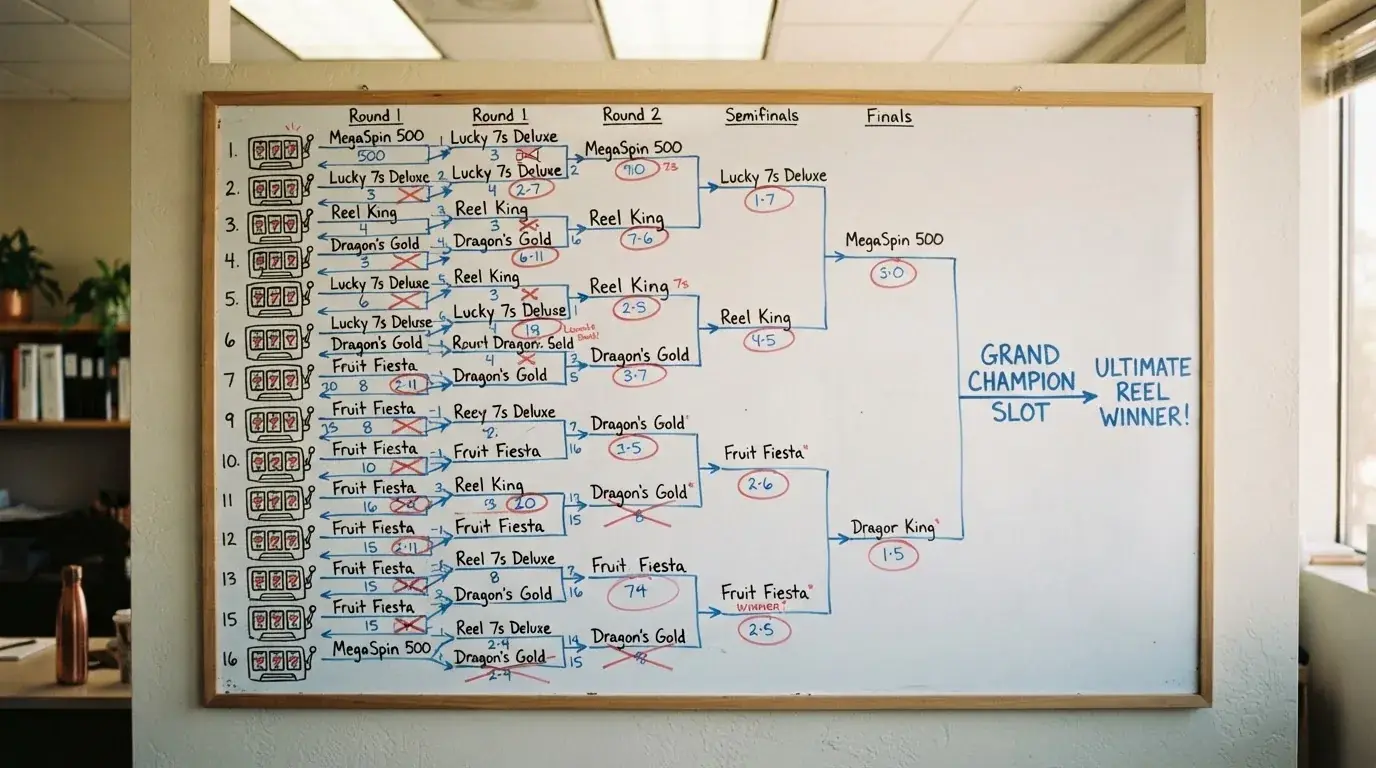
The structural rule that does hold is straightforward: every spin that counts toward the leaderboard has to be a real-money spin on a regulated slot, played under the standard game-cycle stake cap. A freeroll tournament credit is a bonus fund, and the stake on which it is wagered inherits the cap. A single spin can therefore be a “real money” spin for the player, a “bonus” spin for accounting and a “tournament” spin for leaderboard scoring at the same time, and each of those three readings has its own cap, its own conversion rule and its own tax frame.
Live-dealer tournaments appear at some GB-licensed brands but are structurally rarer because live game cycles do not fit the win-multiplier scoring that slot points formulae are built around. Where the operator offers a live-game tournament, scoring is usually points-per-hand or points-per-round rather than win-multiplier, and the rule variations are operator-specific. None of that data is on the register, so none of it can be verified in this format. What the player can verify, before entering, is the licence number, the wagering rule, and the bonus conditions on the prize. Beyond that the comparison section lists every operator licensed to run tournaments on 18 September 2026 with their licence holder, domain status and group structure.
The licensed tournament operators, and what the register actually shows
The table below lists the ten GB-licensed brands whose remote casino operating licences were active on the public register on 18 September 2026. It is not a ranking. The register does not record which of these brands is currently running which tournament format, and at the date of writing there is no verified, comparable dataset across all ten brands for current tournament schedules. The order is the order in which the licence accounts appear in the Commission’s register; the comparison is on the regulatory frame each one sits within, not on the promotional schedule each one runs. The “tournament support” column is shown blank because no comparable, publicly-verified subject data covers it; that absence is itself the finding.
| Brand | Licence holder and remote casino licence | Domain status on the register | Tournament support |
|---|---|---|---|
| Paddy Power | PPB Games Limited — 039411-R-319335-010 | Active (Paddy Power) | — |
| Ladbrokes | LC International Limited — 054743-R-330863-014 | Active (Ladbrokes) | — |
| MrQ | Tek Fox Ltd — 060629-R-337532-004 | Active (MrQ) | — |
| Coral | LC International Limited — 054743-R-330863-014 | Active (Coral) | — |
| bet365 | Hillside (UK Gaming) ENC — 055149-R-331499-004 | Active (bet365) | — |
| Betfred | Petfre (Gibraltar) Limited — 039544-R-319290-010 | Active (Betfred) | — |
| Casumo | Recro Limited — 061549-R-336718-002 | Active (Casumo) | — |
| 888casino | 888 UK Limited — 039028-R-319297-014 | Active (888casino) | — |
| Jackpotjoy | Gamesys Operations Limited — 038905-R-319430-022 | Active (Jackpotjoy) | — |
| Gala Bingo | LC International Limited — 054743-R-330863-014 | Active (Gala Bingo) | — |
Three of the rows above share a single licence: Ladbrokes, Coral and Gala Bingo all sit under the same remote casino operating licence — 054743-R-330863-014, held by LC International Limited. That is the only multi-brand licence among the ten. The three brands share a complaints route, an ADR partner, a GAMSTOP enrolment and a financial-vulnerability framework, and a player excluded via GAMSTOP on any of them cannot open a new account under any of the other two. The table carries ten brand names against fewer rows of independent governance for that reason.
For the rest, each licence is single-brand or sits with a smaller standalone licensee. Hillside (UK Gaming) ENC (bet365) and Gamesys Operations Limited (Jackpotjoy) are the two longer-established single-brand operators in the set. Petfre (Gibraltar) Limited (Betfred), Recro Limited (Casumo), 888 UK Limited (888casino), Tek Fox Ltd (MrQ) and PPB Games Limited (Paddy Power) round out the single-brand set. None of the ten is a white-label operator on the register; each is the direct licence holder for the domain shown.
The notes below spell out what each licence tells the player.
Paddy Power
PPB Games Limited holds remote casino operating licence 039411-R-319335-010 on the Commission’s register, with Paddy Power recorded as an active domain and account 39411 the holder of record. PPB Games is a dedicated operating company for the group’s online casino products, a structure that separates the casino licence from any group bookmaking licence held at a different account. For the player the practical read is that the licence scope covers every casino product the brand runs from Paddy Power under this account, and that the LCCP and social responsibility obligations are satisfied at the operating-company level rather than at any wider group level. The licence’s clean separation is the operator’s strongest legal position to point to.
Ladbrokes
LC International Limited holds remote casino operating licence 054743-R-330863-014, with Ladbrokes.com listed as an active domain. The same licence number appears against Coral and Gala Bingo further down the list. The material read for a tournament player is the consolidated accountability: a complaint, a payout dispute, an ADR ruling or a GAMSTOP block all sit on the LC International account regardless of which of the three brands the player deposited with. The operator’s terms that govern those processes are written at the LC International level rather than at the brand level.
MrQ
Tek Fox Ltd holds remote casino operating licence 060629-R-337532-004, with Mrq.com listed as an active domain. The account number is in the 60,000s — higher than the more established operators — and the smaller commercial footprint is consistent with the operator’s positioning as a slots-focused, mid-sized brand. The standalone licence structure means there are no sister brands on the same account: a query routes to Tek Fox directly, and a complaint routes through that account’s ADR partner without going via a multi-brand operating company.
Coral
Coral sits under the same LC International Limited licence as Ladbrokes, with coral.co.uk listed as an active domain on the register. The .co.uk domain (rather than .com) reflects the brand’s UK market positioning; the Commission’s domain-status flag treats it as a separate entry from the .com cousin. All licence conditions — stake caps, deposit-prompt rule, GAMSTOP enrolment — apply uniformly across the three LC International brands, and the lottery-tickets-style “Coral” product sits on the same operator-side wallet as the slot products the licence covers.
bet365
Hillside (UK Gaming) ENC holds remote casino operating licence 055149-R-331499-004, with Bet365.com listed as an active domain. The “ENC” suffix on the licence holder marks an encumbered licence, carrying one or more conditions beyond the standard LCCP conditions. The encumbrance is routine: it is how the Commission flags additional reporting, financial-reserve or product-scope requirements. Players will not see a different player experience from this naming on the surface; the encumbrance sits in the Commission’s published licence conditions rather than in the lobby.
Betfred
Petfre (Gibraltar) Limited holds remote casino operating licence 039544-R-319290-010, with Betfred listed as an active domain. The “Petfre” prefix is the historic Betfred parent company, and the Gibraltar incorporation is the corporate-vehicle choice through which the online licence is held. Players should not infer a Gibraltar licence from a Gibraltar incorporation; this is a Gambling Commission licence with a Gibraltar-incorporated licence holder, and the two are distinct things. The Commission’s intervention routes apply, not the Gibraltar regulator’s.
Casumo
Recro Limited holds remote casino operating licence 061549-R-336718-002, with Casumo.com listed as an active domain. Recro is the GB-incorporated operating company through which Casumo runs its UK product, separate from any group entity licensed elsewhere. The structure is routine for online operators — a UK licence held through a UK subsidiary while the group is headquartered beyond the UK — and the only material read for the player is that the Commission’s recro account is the routing point for complaints, ADR and GAMSTOP rather than any non-UK entity. The UK-licensed wallet is a clean cut.
888casino
888 UK Limited holds remote casino operating licence 039028-R-319297-014, with 888casino listed as an active domain. 888 UK Limited is the GB-incorporated subsidiary of the wider 888 group, and the account number places the licence among the longer-running entries on the register. The reading for a player is that the GB product is fully inside the GB regulatory frame with no EU-licence fall-back, and the Commission’s intervention routes apply to the licence in full.
Jackpotjoy
Gamesys Operations Limited holds remote casino operating licence 038905-R-319430-022, with Jackpotjoy.com listed as an active domain. The account number sits in the 38,000s, in the same numeric range as 888casino’s 39,028 and Paddy Power’s 39,411, placing the operator among the longer-established licensing accounts on the register. The operator’s UK product runs under Gamesys Operations Limited rather than any wider corporate parent, which means the account is the single point through which a complaint, payout dispute or GAMSTOP exclusion is handled.
Gala Bingo
Gala Bingo closes the set on the same LC International Limited licence as Ladbrokes and Coral, with Gala Bingo listed as an active domain. The brand’s bingo label does not change the licence scope: the same remote casino operating licence covers every product LC International offers under the brand, including the casino wallet that backs any slots play the brand runs. Cross-promotion between Gala Bingo and either of the other two LC International brands runs on the same operator-side wallet, and a single GAMSTOP exclusion covers all three.
What the 10x wagering cap clears to, in time on the slot
The Commission’s 10x wagering requirement cap, in force from 19 December 2025, binds wherever the prize pays in bonus funds or in free-spin winnings rather than as pure cash. The arithmetic below works through the band, because the realised cost varies with the player’s stake cap and the size of the bonus on offer.
The turnover that a bonus requires is the bonus multiplied by ten. A £10 bonus requires £100 of qualifying wagering, a £50 bonus requires £500, and a £100 bonus requires £1,000. The number of spins is that turnover divided by the stake per spin. At the £5 stake cap that applies to players aged 25 and over, £100 of turnover takes twenty spins, £500 takes one hundred spins, and £1,000 takes two hundred spins. At the £2 stake cap that applies to players aged 18 to 24, the same turnovers take fifty, two hundred and fifty, and five hundred spins respectively.
Each spin takes a minimum of 2.5 seconds under the spin-speed rule that has been in force since 31 October 2021, which sets a floor on the time the player spends at the slot. Twenty spins is fifty seconds at the floor; one hundred spins is four minutes ten seconds; two hundred spins is eight minutes twenty seconds. Across the two stake caps the same £10 bonus clears in anywhere from fifty seconds (player 25+, £5 spin) to two minutes five seconds (player 18–24, £2 spin); a £50 bonus clears in anywhere from four minutes ten seconds to ten minutes twenty-five seconds; a £100 bonus clears in anywhere from eight minutes twenty seconds to twenty minutes fifty seconds. Slower play extends those numbers; faster play is not allowed.
That is the realised time cost of clearing a bonus-funded tournament prize at the floor the rules now set. None of the figures includes the spin interval a player chooses; the floor is fixed and a slower pace is the only direction the time can move.
The broader reading the band does: the 10x cap is a ceiling on the rollover, but the realised cost depends on the bonus amount offered and the stake cap the player sits under. A player entering many small tournaments accumulates many short clear sessions measured in minutes; a player targeting the headline bonus clears a much larger turnover over a longer window. The cap’s market effect will be most visible in headline prize sizes, which are contracting, and in the rollover previously advertised on smaller bonuses, which is also contracting.
Frequently asked questions
How does a slot tournament actually work at a UK casino?
A slot tournament at a GB-licensed casino is a time-bounded competition against a fixed prize pool. Players earn points — almost always on a win-multiplier formula — by spinning one or more nominated slots inside the window, and the top finishers split the pot. Entry can be paid (a buy-in) or “free” (a freeroll credit), and from 19 December 2025 any bonus funds or free-spin winnings paid as the prize are bound by the 10x wagering cap.
Can a slot tournament be entered without making a deposit?
At a GB-licensed brand, yes — via a freeroll. A free-entry credit is usually bonus funds rather than cash, and the resulting prize inherits the 10x wagering cap and is paid only after the rollover clears. The deposit prompt in force since 31 October 2025 still applies to the qualifying deposit that funds any paid entry, even where the entry itself is credited free of charge.
What decides where a player sits on a tournament leaderboard?
Almost every slot tournament scores on win-multiplier — your largest single-spin win divided by your stake. A long-shot payout scores heavier than twenty small wins of the same total value. Some live-dealer or hybrid tournaments use points-per-hand or points-per-round instead, and a few run a flat-spins-counted formula; the points rule is the first thing to read on the terms page.
How fast do tournament prizes reach the player’s account?
That depends on the prize shape and the payout rail. Pure-cash prizes are usually released within minutes to a few hours once an operator’s manual review completes. Bank-transfer payouts route over Faster Payments, which arrives in seconds; card and e-wallet payouts typically take one to three business days. Bonus-fund and free-spin prizes are not “paid out” until the 10x wagering is cleared in full, after which the cleared balance can be withdrawn through the same rails.
Does paying in by cryptocurrency change how a slot tournament entry works?
Inside the GB regulatory frame, no. A licensed operator verifies identity before the first deposit regardless of the rail, and a Bitcoin or other cryptocurrency deposit is treated exactly the same as a debit-card deposit for source-of-funds purposes. The differences live at unlicensed offshore operators, where the absence of the GB licence means no GAMSTOP, no Commission-mediated complaints and no enforced payout rules — a separate product rather than a different payment method.